
Modern manufacturers operate in a world driven by speed, precision, and cost control. Business enterprises need to maintain precise production schedules, reduce waste, and enhance inventory management. With the help of just-in-time manufacturing, businesses can produce items based on the actual demand rather than overestimated demand.
JIT manufacturing, or just-in-time manufacturing, focuses on production that is driven by demand. Instead of holding large inventories, factories receive materials only when production requires them. With this lean manufacturing approach, cash flow is improved, and storage expenses are decreased.
Manufacturers across heavy industries, automotive, healthcare, and many more adopt JIT to stay competitive. But for JIT to be implemented successfully, strict production control, strong supply chain management, and real-time visibility are necessary. Without digital support, JIT systems face serious risks.
What is Just in Time Manufacturing?
Just in Time manufacturing is a production method that reduces inventory and produces goods based on actual demand. Factories avoid large stockpiles and instead schedule materials to arrive exactly when demanded.
This JIT manufacturing approach reduces storage costs and limits the risk of obsolete inventory. It also helps companies respond faster to customer orders and market changes.
The concept gained global recognition through the production system of Toyota Motor Corporation. Toyota’s lean manufacturing model focused on waste reduction, demand alignment, and continuous improvement.
Today, many manufacturers unlock powerful results with digital transformation projects with JIT concepts. They depend on smart manufacturing platforms, industrial IoT, and linked systems to keep operations running smoothly.
A Brief History: From Toyoto to the Global Standard
The Post-War Origins
Just-in-time manufacturing was born out of necessity. After World War II, Japan faced severe shortages of capital, natural resources, and industrial space. Companies like Toyota could not afford to warehouse large quantities of raw materials or finished goods. They had to find a way to produce efficiently with limited resources.
Taiichi Ohno, an industrial engineer at Toyota Motor Corporation, is widely credited as the father of JIT. Through the 1950s and 1960s, he developed what became known as the Toyota Production System (TPS) — a framework built around producing only what is needed, when it is needed, in the amount needed.
Ohno was reportedly inspired by the American supermarket model: shelves are restocked based on what customers actually take, not based on predictions. He applied this pull-based logic to manufacturing, and JIT was born.
The Oil Crises and Global Proof
Toyota’s JIT system was put to the test during the 1973 oil crisis. While competitors struggled with bloated inventories and rising costs, Toyota’s lean model helped it weather the storm. Other manufacturers took notice.
Throughout the 1980s and 1990s, JIT principles spread globally — first to other Japanese industries, then to Western manufacturers in automotive, electronics, and consumer goods. By the early 2000s, JIT had become the dominant production philosophy in modern manufacturing.
The 2020s: A Stress Test
The COVID-19 pandemic, the Suez Canal blockage in 2021, semiconductor shortages, and geopolitical tensions, including the Russia-Ukraine war, all exposed the fragility of hyper-lean supply chains. The JIT model faced its most serious challenge since its creation.
But the story is not that JIT died. It evolved. The 2020s taught manufacturers that pure JIT needs to be balanced with strategic resilience – and the best operators in the world are now running sophisticated hybrid models. More on this in Section 8.
How JIT Manufacturing Works – The Core Principles
The 5 Zeros define the operational discipline necessary for effective just in time manufacturing. These principles of JIT emphasizes on enhancing production control, cutting down on delays, and getting rid of waste.
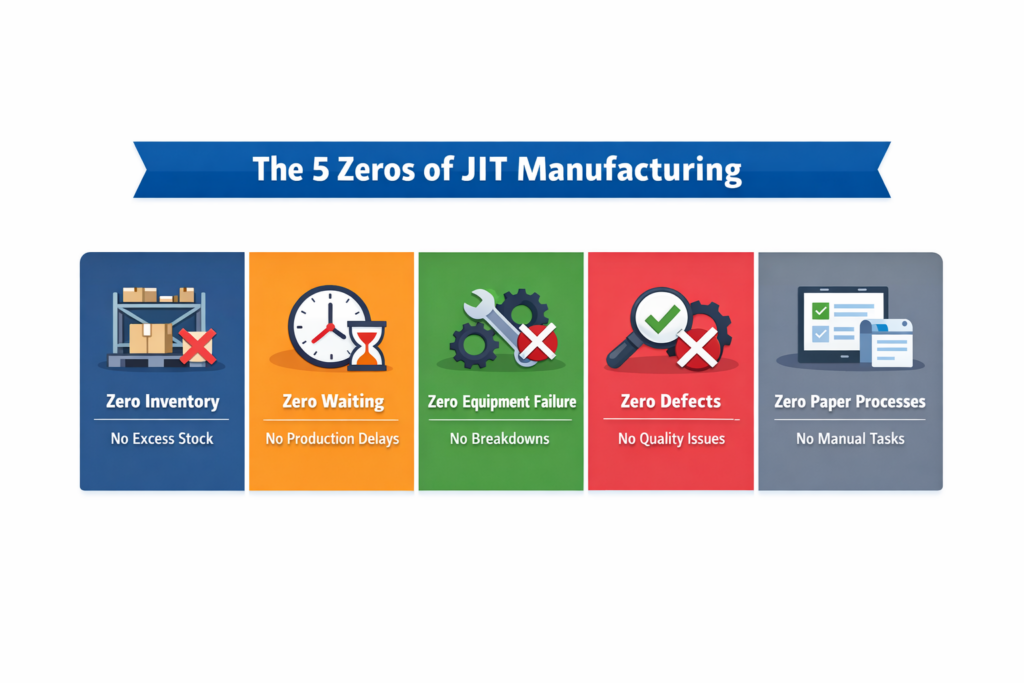
1. Zero Excess Inventory
JIT’s main purpose is to eliminate excess work-in-progress stock, finished items, and raw materials. Inventory should arrive exactly when needed for production.
Overstock conceals manufacturing inefficiencies and locks capital. By maintaining low inventory levels, businesses can retain better cash flow and clear visibility into demand trends.
Inventory in lean manufacturing systems should move constantly rather than sitting idle in storage locations.
2. Zero Waiting Time
The production flow must be continuous from start to end. Delays between processes enhance waiting periods and decrease efficiency.
Waiting might be caused by delayed material supplies, machine downtime, unclear work instructions, or pending approvals. Just-in-time manufacturing reduces disruptions by coordinating scheduling, collaboration, and workflow coordination.
Shorter waiting times lead to faster order fulfillment and a stronger production cycle.
3. Zero Equipment Failure
Reliable machinery is needed for Just-in-Time production. With no buffer inventory, a single breakdown can shut down the entire manufacturing process.
Preventive maintenance is essential in reducing unplanned downtime. Regular inspections, performance tracking, and timely maintenance enhance equipment longevity.
Stable machines are a foundational element of stable production.
4. Zero Defects
Quality must be monitored at all stages of manufacturing. Defects in JIT systems create rapid interruption, as there is no extra stock to replace defective parts.
Workers must identify and correct issues during the process, not after completion. Early detection reduces rework costs and protects customer satisfaction.
Workers must discover and resolve difficulties throughout the process, not after it is completed. Corrective action lowers rework costs and ensures customer satisfaction.
High quality standards strengthen lean manufacturing techniques.
5. Zero Manual Paper Processes
Paper-based manual processes slows down decision-making and increases the risk of human errors. Manual reporting also causes delays in data visibility.
Digital systems enhance production transparency by gathering real-time data from the shop floor. Automated reporting decreases the administrative burden while improving accuracy.
Data visibility improves production scheduling and supply chain collaboration.
Modern manufacturers add a sixth zero to this list: Zero Accidents. A safe, well-trained workforce is essential to sustaining JIT operations at high performance levels.
The 7 Wastes JIT Eliminates
The Toyota Production System identified seven types of waste that JIT targets. Understanding these helps you spot where your own operation is losing money:
- Overproduction: Making more than customers need. This is considered the worst waste in TPS because it creates all other wastes downstream: extra inventory, extra transportation, extra storage, and extra risk.
- Waiting: Any time a worker, machine, or material is idle waiting for the next step. This includes waiting for parts to arrive, for machines to be repaired, or for instructions to be issued.
- Transportation: Moving materials or products unnecessarily. Every extra move is a risk of damage and a cost with no value added to the product.
- Overprocessing: Doing more work on a product than the customer requires. This includes unnecessary finishing, over-engineering, or redundant inspections.
- Excess Inventory: Raw materials, work-in-progress, or finished goods held beyond immediate need. Inventory consumes capital, space, and management attention while adding no value.
- Unnecessary Motion: Workers moving more than needed to perform their tasks. Poor workplace layout, unclear work instructions, or searching for tools all fall into this category.
- Defects: Producing defective units requires rework or scrapping, wasting materials, labor, and time. Defects discovered late, especially by customers, damage the reputation.
6 Major Benefits of Just in Time Manufacturing
JIT manufacturing leads to significant enhancements in production control, cost efficiency, and operational effectiveness.
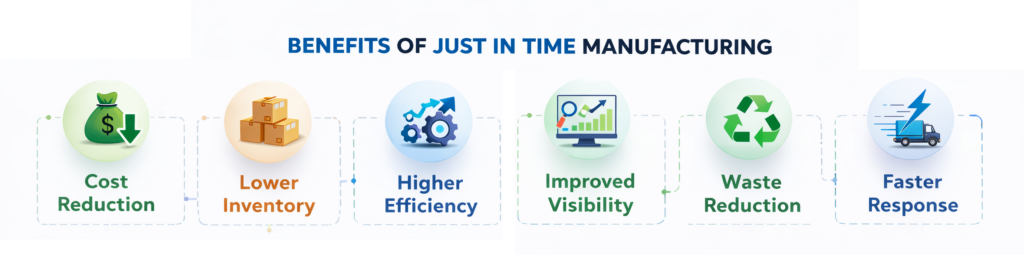
1. Lower Inventory Holding Costs
JIT manufacturing reduces warehouse storage needs and surplus material purchases. These businesses save money on insurance, shipping, and storage costs.
Improved inventory management contributes to better financial performance.
2. Better Cash Flow
Capital invested in excess inventory is lowered with the help of lean inventory management techniques. Companies are able to invest in expansion or innovation while keeping cash on hand.
Cash flow stability supports long-term growth strategies.
3. Higher Production Efficiency
Demand-driven production eliminates unnecessary stages of manufacturing. Teams are able to prioritize tasks that support customer orders.
This reduces operational delays and increases production efficiency.
4. Improved Supply Chain Visibility
JIT encourages transparent tracking of material flow and supplier schedules. Businesses maintain better control over procurement timelines.
Real-time information enhances supply chain management decisions.
5. Reduced Waste and Rework
Lean manufacturing principles minimize scrap and defective output. Early quality inspection checks reduce material waste and rework costs.
Waste reduction directly improves profitability.
6. Faster Market Responsiveness
JIT manufacturing supports flexible production scheduling. Companies adjust output volumes quickly based on demand shifts.
This agility strengthens competitiveness in dynamic markets.
How to Implement Just in Time Manufacturing
Just in Time production necessitates planning, discipline, and high operational visibility. Business enterprises must prepare their manufacturing processes prior to decreasing inventory levels.
JIT performs best when people, processes, and technology are aligned to achieve lean production goals.
1. Analyze Current Production and Inventory Levels
First of all, start by examining existing inventory management processes. Identify where surplus stock arises and why it does.
Many businesses keep extra inventory to compensate for inefficiency. Prior to decreasing inventory buffers, JIT needs to recognize these underlying concerns.
2. Improve Demand Forecasting and Production Scheduling
Accurate demand data is the core of JIT production. Production schedules must closely match actual client orders.
Companies should shift from forecast-driven production to demand-driven production systems. This reduces overproduction and improves order accuracy.
3. Strengthen Supplier Relationships
JIT manufacturing relies largely on trustworthy suppliers. Manufacturers must collaborate closely with vendors to plan delivery dates and quantities.
Clear collaboration and clear timeframes help prevent material shortages. Supplier dependability directly affects industrial stability.
4. Stabilize Equipment Through Preventive Maintenance
Machine dependability is crucial in lean manufacturing processes. Without sufficient inventories, equipment breakdowns cause rapid disruptions in operations.
Businesses must implement preventative maintenance plans. Regular inspections and performance tracking help prevent unplanned downtime.
5. Standardize Work Processes
JIT necessitates alignment across shifts and departments. Standard operating procedures assist in maintaining manufacturing accuracy.
When frontline workers follow precise and clear interactive work instructions, variability is reduced. Standardization enhances both quality control and workers’ productivity.
6. Introduce Pull-Based Workflow Systems
Implement a pull mechanism that adjusts production based on real demand. Visual cues or digital dashboards can help determine when to start manufacturing.
Pull systems avoid overproduction and ensure that each step meets downstream needs.
7. Reduce Batch Sizes Gradually
Large batch production raises inventory levels and hides flaws. JIT promotes lower batch sizes to increase performance.
Smaller quantities reveal inefficiencies rapidly. Teams can tackle issues before they lead to severe issues.
8. Invest in Real-Time Visibility and Digital Tools
Manual methods cause delays and reduce operational transparency. JIT manufacturing necessitates real-time visibility of inventories, assets, and task progress.
Digital platforms include production tracking, maintenance notifications, and real-time communication. This enhances collaboration among departments.
9. Train and Engage the Workforce
Employees play a critical part in JIT success. Workers need to understand lean concepts and quality control.
Training sessions should focus more on waste reduction, early fault discovery, and regulated workflow operation.
10. Monitor Performance and Improve Continuously
JIT implementation does not stop with the initial setup. Business enterprises must monitor performance metrics, including lead time, downtime, defect rates, and inventory turnover.
Regular reviews help teams identify improvement opportunities. Continuous improvement contributes to long-term production stability.
Common JIT Implementation Mistakes (and How to Avoid Them)
Even well-intentioned JIT implementations fail. These are the most common reasons why:
Mistake 1: Running down inventory before the supply chain is ready
This is the most dangerous mistake. Reducing safety stock before suppliers are verified and reliable creates production stoppages that damage customer relationships and demoralize the implementation team. Always verify supplier performance before reducing buffers.
Mistake 2: Treating JIT as purely an inventory project
JIT is a systems change that touches production scheduling, supplier contracts, quality management, workforce practices, and technology. Teams that approach it as “let’s just carry less stock” miss the foundational changes that make low inventory sustainable.
Mistake 3: Skipping the workforce training
Workers who don’t understand why processes are changing — or who haven’t been trained on Kanban, changeover procedures, and quality at source — will revert to old habits under pressure. Invest in training before and during implementation.
Mistake 4: Applying JIT uniformly to all products
Not every product is a JIT candidate. Seasonally volatile products, custom or low-volume items with unpredictable demand, or items with very long supplier lead times may require different inventory strategies. Segment your portfolio and apply JIT selectively.
Mistake 5: No leadership commitment
JIT creates short-term disruption before delivering long-term gains. If leadership is not committed to the program through initial turbulence, it gets abandoned prematurely. Get explicit commitment from the top before starting.
Mistake 6: Ignoring maintenance
With zero buffer inventory, a single machine breakdown stops the line. If preventive maintenance is not already robust, fix it before reducing inventory. Equipment reliability is a non-negotiable prerequisite for JIT.
Is JIT Still Relevant in 2026? The Post-COVID Reality
This is the question every operations manager is asking. The honest answer is: yes, but not in its original form.
The pandemic revealed that the hyper-lean JIT model — where some automakers held less than half a day of supply of certain components — was brittle under stress. Around 64% of companies surveyed post-pandemic reported pivoting from JIT toward just-in-case (JIC) strategies to improve resilience.
But the story is more nuanced than “JIT is dead.”
A research paper analyzing Toyota, Inditex, and Amazon between 2018 and 2024 found that all three companies moved toward a hybrid model, not a wholesale rejection of JIT. Toyota kept JIT for predictable components while adding strategic buffers for vulnerable ones. Amazon expanded fulfillment capacity and upstream inventory, moving toward a JIC posture. Inditex balanced rapid product cycles with strategic readiness stock.
JIT vs JIC: Which Model Is Right for You?
| Factor | JIT (Just-in-Time) | JIC (Just-in-Case) | Hybrid |
| Primary goal | Efficiency, cost reduction | Resilience, continuity | Balance of both |
| Inventory Level | Stable demand, reliable supply | Volatile demand, critical components | Most modern manufacturers |
| Capital efficiency | High | Lower | Medium-high |
| Supply chain risk | High | Low | Managed |
| COVID response | Vulnerable | Better protected | Most resilient |
| Cost | Lower in stable conditions | Higher carrying costs | Optimized |
| Best for | Stable demand, reliable supply | Volatile demand, critical components | Most modern manufacturers |
How Plutomen Strengthens Just-in-Time Manufacturing
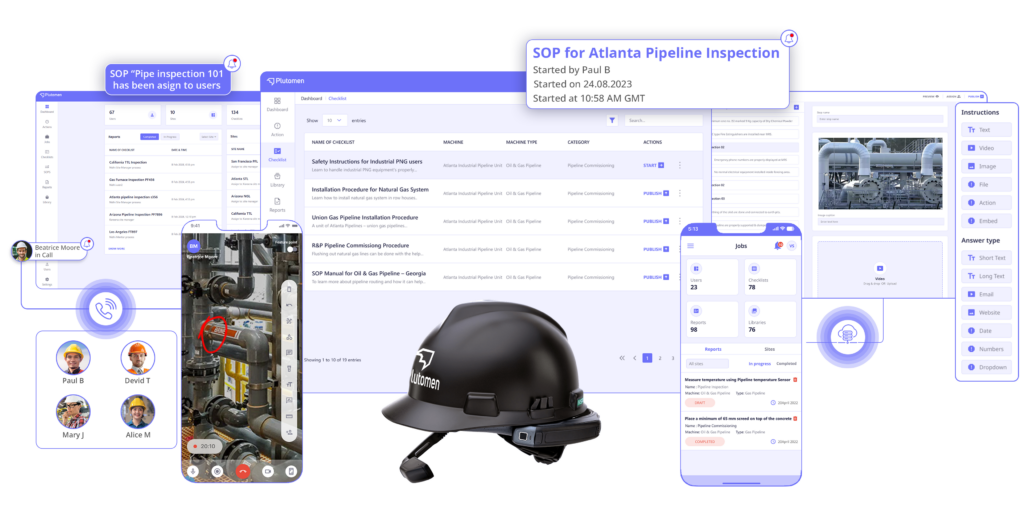
Plutomen offers AI & XR-Powered Connected Worker Solutions to empower the frontline with “on-the-job” communication, work assistance, and training in the form of digital guidance.
Digital work instructions guide operators step by step during assembly, inspection, and maintenance tasks. This reduces human error and improves production accuracy.
Supervisors track job completion status through live dashboards. Real-time visibility improves production scheduling decisions.
Remote assistance features connect workers with experts instantly. This reduces downtime during equipment troubleshooting.
Plutomen also supports preventive maintenance workflows. Early issue detection prevents unexpected breakdowns that could disrupt JIT production cycles.
Real-Time Asset Management for Lean Production
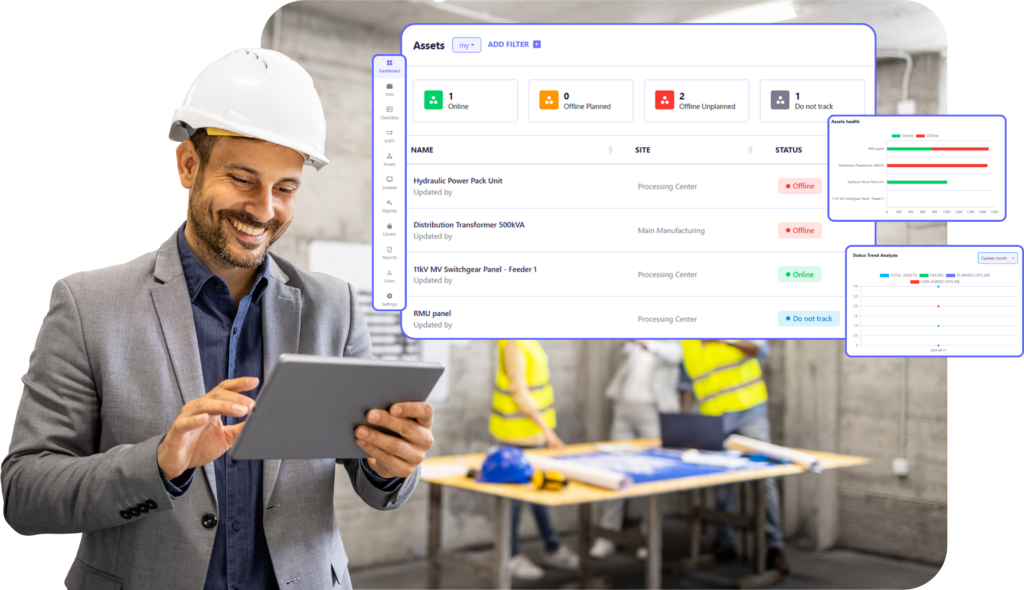
Equipment reliability plays a critical role in JIT manufacturing success. Unexpected machine failures stop production immediately.
Plutomen’s asset management module provides structured tracking of equipment health, inspection records, and maintenance history. Managers gain clear visibility into asset performance.
Preventive maintenance improves machine reliability and supports continuous production flow. Stable equipment performance strengthens lean manufacturing systems.
Workforce Productivity in Demand-Driven Production
In Just-in-Time manufacturing, worker efficiency directly affects production flow. Teams must complete tasks accurately within tight timelines.
Plutomen supports frontline productivity with digital guidance and live collaboration. Workers access updated instructions through connected devices.
Reducing information gaps improves task accuracy and production efficiency. New operators adapt faster in lean manufacturing environments.
Building a Resilient JIT Supply Chain
Supply chain management determines the success of Just in Time manufacturing strategies. Material delays can create immediate production bottlenecks.
Digital coordination improves tracking of inbound materials and supplier schedules. Managers respond quickly when disruptions occur.
Plutomen strengthens communication between operations teams and supply chain partners. Real-time updates reduce uncertainty and maintain demand alignment.
Just in Time Manufacturing in the Era of Smart Manufacturing
Smart manufacturing combines lean production with digital intelligence and automation. Just-in-Time manufacturing fits naturally within this evolution.
Connected platforms, industrial IoT, and manufacturing automation support accurate production scheduling. Real-time analytics improve inventory management decisions.
Companies that integrate JIT with connected worker technology build stronger operational resilience. They maintain waste reduction while improving response speed.
Plutomen supports this shift toward connected, data-driven manufacturing systems. The platform strengthens visibility, maintenance control, and frontline coordination.
Conclusion: Transforming Just-in-Time Manufacturing with Connected Worker Technology
Just in Time manufacturing remains one of the most effective lean manufacturing strategies for waste reduction and inventory control. It aligns production with real demand and improves financial performance.
However, JIT requires disciplined supply chain management, preventive maintenance, and real-time visibility. Without digital support, production risks increase.
Manufacturers who integrate Just in Time manufacturing with smart manufacturing technology gain greater control over inventory, scheduling, and workforce performance.
Frequently Asked Questions

Keyur B
CEO, Founder of PlutomenWith more than 12+ years of experience in the world of enterprises, technology, and metaverse, Keyur Bhalavat is leading Plutomen to gain meaningful partnerships & to have a strong clientele network. He is one of the board members of GESIA (Gujarat IT Association Ahmedabad).






![13 Operational Challenges in Manufacturing Industry [2022-23 Edition]](https://pluto-men.com/wp-content/uploads/2022/12/Challenges-in-Manufacturing-1.png)