Modern-day industries face a lot of challenges. Beginning from aligning their legacy machines with modern-day technology to hiring the right people to operate them, there are a lot of complications. In today’s time, when the competition is super stiff, the need for the right workforce is imperative.
And the story does not end here; the workforce should be open to adaption to new technology. You see, as technology is evolving, the need for evolving staff is necessary. This is the problem that most organizations face. As per stats, by 2030, around 85 million jobs across the globe will go unfilled. This can lead to a loss of $8.5 trillion.
Another interesting stat relates to the job-switching trend. With the rise of technologies like AI, automation, etc., around 14% of the workforce across the globe will be forced to switch jobs. This directly relates to the need for employees to upskill.
In this blog, we will analyze the skill gap factor and explore how AR can help in closing the skills gap at your organization.
What is Skill Gap and Why is it Necessary to Address It?
As per the basic definition, a skill gap is the difference between an employee’s skills and what the job requires. For example, if a job requires working with hardware equipment but the employee only knows about the software, there is a skill gap.
The skill gap is a key issue for organizations today. As per Gartner, around 58% of the employee need new skills to do their job better. And it is not just about the workforce. Organizations tend to lose a lot of people with the right skills. As mentioned above, by 2030, the revenue loss due to a lack of skilled people will reach $8.5 trillion. Hence, it is crucial to address the skill gap.
Here are some other crucial reasons to address the skill gap!
Competitiveness
The number one reason for addressing the skill gap for businesses is competition. Most of the top organizations have these highly skilled employees, which is why they pose serious competition to other companies. As per stats, 43% of organizations struggle to hire appropriate candidates because of the competition from other firms.
Rising Unemployment Rates
Unemployment is the termite that is eating the talent of every country. Moreover, it is also the reason skill gaps are created. As per stats, only 48.7% of the youth in India are employable; the rest cannot be employed. Why? Due to skill gap. As per a survey, 75% of the companies report a skill gap high unemployment rate.
Technological Advancements
The third reason in line to address the skill gap is technological advancement. You see, a workforce that is old may not be able to adapt to the changing technology trends quickly. This is one of the challenges of businesses today. The inability of frontline workers to adapt to new technologies causes a skill gap and boosts unemployment.
Future-proofing
It is pretty obvious that if the competition is increasing and technology is advancing, the skill gap needs to be addressed faster, not just for the present but for the future.
Economic growth
The power of a business lies in its workforce. And if the workforce is not equipped with the right tools and skills, the business will fail. Moreover, it will become tough for workers to keep up the productivity if they don’t know how to operate the new machines. Hence, affecting the overall economic growth.
Examples of Skill Gaps in the Workforce
Usually, a gap can occur in terms of hard skills involving technical expertise or soft skills such as effective collaboration and interaction. Although the most common factor of the skills gap is the increased adoption of emerging technologies, there are numerous other factors where workers are facing the issues. Below are some examples which are prone to skill gaps:
Pace of Innovation
One of the visible reasons for the skill gap is the pace of innovation. As technology is racing towards being better, industries are in a perplexed state regarding their use. On the one hand, companies require to adopt technologies like IoT, AR, AI, and more to address the competition.
However, on the other hand, they need to solve the skill gap that awaits them after using these technologies. Therefore, the pace of innovation leads to a skill gap. As per World Economic Forum, around half of the workers across the globe will need reskilling by 2025 to keep up with the pace of innovation.
Equipment Operation and Maintenance
A disparity often arises in the proficiency of operating and maintaining equipment, especially when confronted with modern, complex machinery.
Ineffective or Inadequate Training
If your firm is facing a skill gap, it can probably be due to ineffective or inadequate training. Whenever an employee joins an organization, they need some sort of training to work in the firm. If this training lacks the elements that are part of future trends, a skill gap can occur in the future.
Most businesses miss the element of digital training. They fail to inform and train the workers on digital technologies.
Outdated Tools
Tools play a pivotal role in working for a workforce, whether physical tools or software. And no matter which one it is, if it is not updated with time, it can cause many problems. Outdated tools can reduce productivity and may take more time to complete the work.
While your competitors might be using the most advanced tools for their work, your workers may experience a skill gap due to the same.
Retiring Workforce
When skilled experts are approaching retirement, they often take with them a lot of expertise, skills, and insights they have developed over time. If there is no effective system for knowledge transfer in place can create a gap that is difficult to close.
Increasing Complexity
When we look at technological advancements today, they make everything a bit easier to do. An example of this is the use of AR. Using Augmented Reality, a remote technician can make repairs faster. However, in earlier times, it wasn’t that easy to read the manual entirely and then perform the operations.
In short, complexity can make a difference. If the complexity in your way of working is more, it can lead to a skill gap. And to be precise, it is a performance gap.
Ways to Close the Skills Gap With Augmented Reality
So, no matter what kind of business you have, you may face a skill gap one day or the other. It could either be a knowledge gap or a performance gap. Here are some ways to bridge the skills gap with augmented reality.
Introduce Training and Development Programs
One of the prime ways to deal with a skill gap is through training. Providing your staff with the right training at the right time keeps them ready to take on any challenge at any time. Further, with the use of AR, you can make the training better and more interactive.
For instance, most manufacturing businesses are implementing AR into their workflow. Why? Its numerous applications, like remote assistance, inventory management, etc., make the technology demanding. In training, businesses can use AR to provide an immersive experience to the employee by providing them with digital work instructions.
Further, AR can also be used to provide augmented views of machines and their parts via smart glasses for a better understanding. One of the finest examples of this is Boeing which uses AR to cut training time for electric wiring.
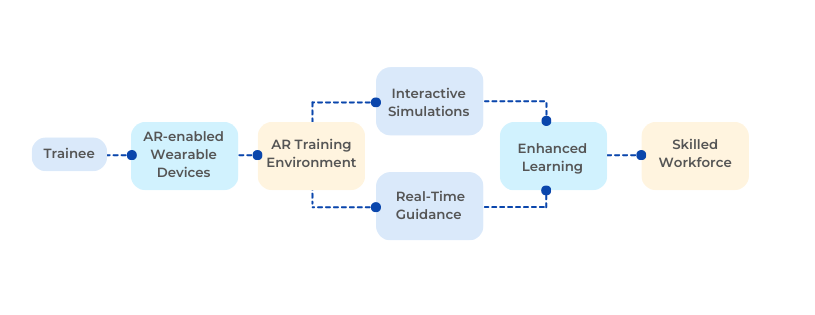
The above diagram showcases the augmented reality flow chart starting from worker trainees using AR-enabled wearable devices to access interactive simulations and get real-time support for developing a skilled workforce.
Enhance Workplace Safety & Engagement
In field jobs, the safety of the employees is of utmost concern. If your company offers required workplace security to the frontline workers and employees, it is highly unlikely for the employees to quit.
Conversely, employee engagement decides how long an employee will stay with the company. As per stats, companies with highly engaged workforces are 21% more profitable. Moreover, these companies are at less risk of losing their best employees.
In both cases, the skill gap can be reduced if the required measures are in place. Therefore, Make your production, maintenance, and repair process interactive and safe with AR to address the skill gap. Further, employ AR methods in training and on the floor to make their experience more engaging.
Remote Expert Guidance:
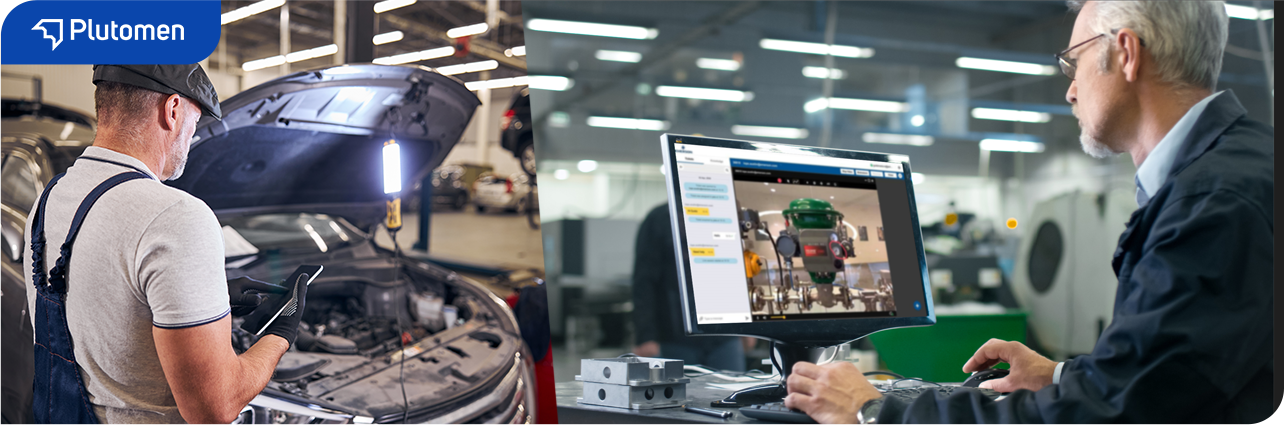
With the help of AR remote assistance, frontline workers can connect with experts and get guidance in real-time with hand-drawing, marking, or writing texts in the form of AR annotations. This is extremely essential in situations where immediate guidance is required. A field technician working on complex machinery can wear AR smart glasses that allow a remote expert to assist them through intricate repairs.
Interactive and Immersive Learning Experience
The skill gap results from workers leaving the organization for a better workplace. Think about it. If you could provide your frontline workforce with an interactive and immersive learning experience, they may never think of switching jobs. Hence, resolving your skill gap issue.
Real-World Applications of AR
To fill the skill gap, almost every industry can use AR. It can be in terms of training, field support, on-floor support, etc. The key thing is to address the skill gap issue successfully.
1. Manufacturing Industry
The manufacturing industry is one of the prime users of AR. Hence, it can fill the skill gap much quicker. The manufacturing industry can use AR to train employees, check product quality, enhance workplace safety, and more.
An example of this can be Bosch. Bosch uses AR to train their employees and for intricate repair work. Bosch uses HoloLens Glasses 2 to help the learners in various ways, like
- Receiving visual guidance on the screen of the glasses.
- Interact with visual objects
- Get step-by-step visual instructions.
2. Healthcare Sector
In the healthcare sector, the telemedicine sector can leverage the power of AR to improvise its operations, showcasing the benefits of augmented reality in healthcare. Telemedicine involves the provision of remote clinical services via network-based communication between the patient and the doctor, primarily facilitated by an app.
Some of the primary use cases of AR in healthcare are as follows!
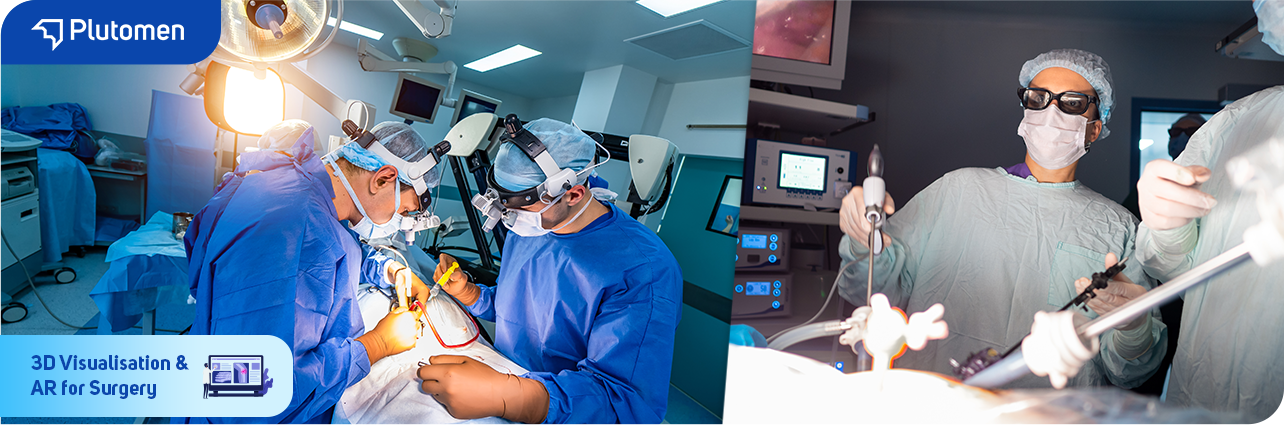
Xvision Spine Systems has developed a state-of-the-art AR surgical guidance system. Augmedics allows doctors to see through the human body’s tissues during surgery, just like X-ray vision. This enables surgeons to carefully and easily navigate surgery instruments.
Eyedecide is an awesome app that makes eye diagnosis easy for doctors. It uses the camera display to simulate the eye anatomy of a patient. Doctors can use this to identify the eye condition and suggest solutions based on the same.
3. Field Service Management
Field service management is a part of numerous types of businesses. And many of them worldwide are using AR to help their field technicians. Let’s understand it with some examples!
BID is a wood processing solution provider that uses AR software to assist remote customers in resolving technical issues. For instance, if the customer has an issue at its end, the experts at BID can provide on-screen instructions and guidance annotations through real-time audio and video technology.
Case Construction Equipment uses an AR app to help its customers and technicians engage with its products better. The AR app enables interactive 3D features like videos, animations, voice-supported text, etc. It can help technicians understand the machines better while on the field.
[Ebook] Augmented Reality Applications on Factory Floor
Learn how augmented reality benefits in streamlining factory floor operations.
Get the eBook now!How can Plutomen Help in Closing the Skills Gap?
Plutomen is an ingenious AR solution provider that aims to resolve the skill gap issue of industrial enterprises worldwide. With their innovative solutions backed by AR, Plutomen offers firms a great opportunity to enhance their workflow.
Plutomen Connect: Plutomen Connect is a remote assistance solution that allows technicians in the field to get expert assistance via video conferencing. The solutions allow the experts to provide annotations to speed up the repair and maintenance process.
Plutomen Workflow: The tool introduces digital work instructions to streamline various tasks for frontline workers and service technicians.
Plutomen Assist: Plutomen Assist is a training tool that uses immersive AR to impart technical skills to your new employees.
Bridge Workforce Skill Gaps With Plutomen AR-Powered Solutions
Elevate Your Organization’s Capabilities And Empower Your Frontline Workforce With Augmented Reality
Request DemoFrequently Asked Questions

Keyur B
CEO, Founder of PlutomenWith more than 12+ years of experience in the world of enterprises, technology, and metaverse, Keyur Bhalavat is leading Plutomen to gain meaningful partnerships & to have a strong clientele network. He is one of the board members of GESIA (Gujarat IT Association Ahmedabad).