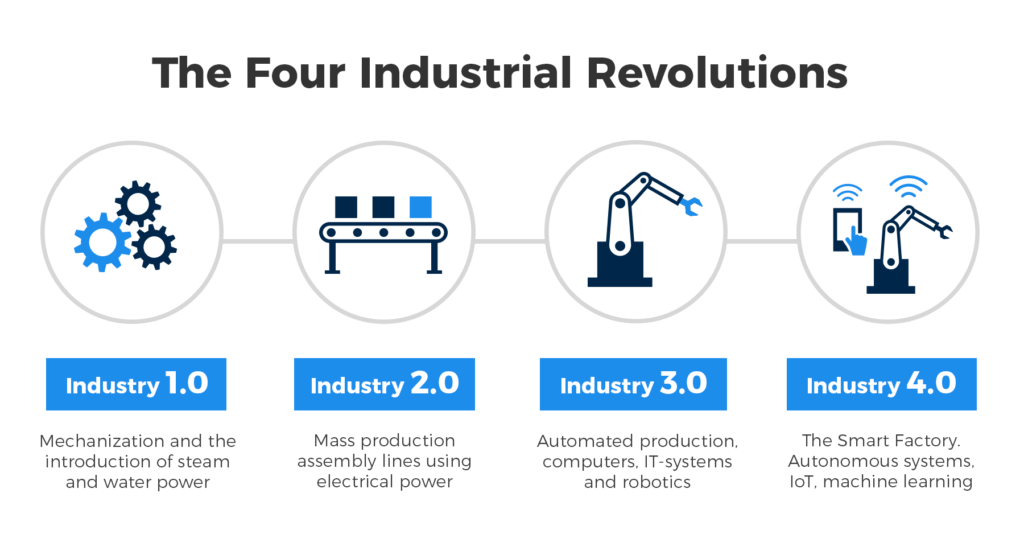
Industry 4.0 indicates the transformation and the rise of new industrial digital technology, which makes gathering and analyzing the data across various machines possible, resulting in faster, flexible, and more efficient processes. This revolution has increased productivity and fostered industrial growth that changes the competitiveness of companies and regions.
Source : elinext
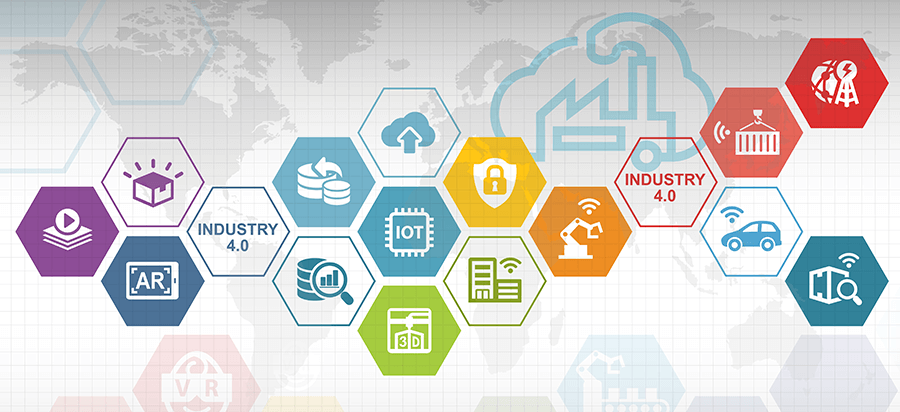
We are now in the Information Age. More data has been created in the last three years than ever been created before. It is not about the amount of data created, but it is about how it improves the decision making. This is when smart connections are relevant. The information needs to be collected at the right time, at the right point and showcased in the right context. Machines and people are always connected in the era of industry 4.0 , hence, enhancing the industrial processes. This revolution doesn’t depend on one technology, but several technologies. Among these technologies is Augmented Reality. Let us see how these technologies impact the revolution of Industry 4.0.
Strengths and weaknesses of AR in production
Strengths of AR in production
Increased productivity : Augmeted reality for industrial applications have shown a significant positive impact on productivity in industrial manufacturing. Tasks, both complex and simple, can be completed faster with the assistance of AR glasses, leading to time savings of up to 44% on average.
Process optimization : AR is particularly effective in areas where process optimization has already been implemented or is near completion. By providing real-time information and guidance, AR can further enhance and streamline production processes.
Support for short tact time : In production areas where a short tact time is crucial, AR can be highly beneficial. It enables workers to access relevant information quickly and perform tasks efficiently, contributing to improved production cycle times.
Weaknesses of AR in production
Reduced learning effect : One disadvantage of AR technology is that it may hinder the depth of learning compared to traditional analog working methods. The information provided by AR may not be absorbed as comprehensively, potentially limiting the learning potential for employees.
Potential impact on innovation : The study suggests that the group working without AR technology generated more helpful suggestions for process improvement. This implies that AR applications might not stimulate employee creativity and innovation to the same extent as traditional working methods.
Overall, AR in production offers clear advantages in terms of productivity improvement, process optimization, and support for time-sensitive operations. However, it should be noted that there are potential drawbacks related to reduced learning depth and potential impact on employee innovation. Proper assessment and consideration of these factors are essential for successful implementation of AR in manufacturing environments.
Augmented Reality in Industry 4.0
Augmented Reality (AR) identifies the set of technologies which allows viewing the real world environment in an augmented or enhanced way through computer-generated graphics. This visual aspect in the physical environment is enhanced by using various devices. Augmented reality has varied applications, but manufacturing is one domain which can be most attractive for the world of augmented reality.
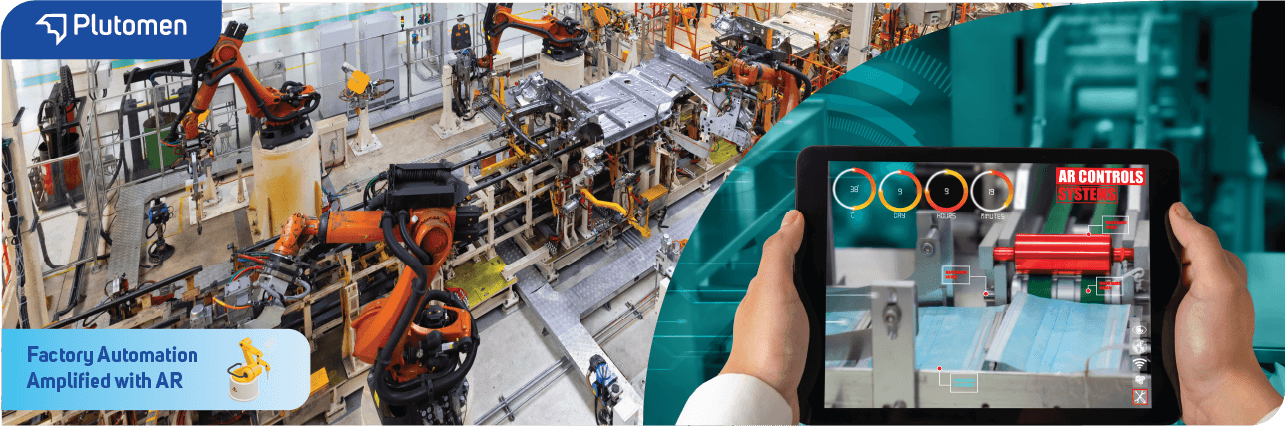
Concerned with various processes to transform raw materials in the finished goods by adding value to it, Augmented reality in Industry 4.0 can be a real game changer. This is because real-time information is needed at the various stages of product life cycle. From design to prototyping, to production and assembly, maintenance, each stage has its own sets of challenges. Augmented reality can be a boon in these complex processes as it is capable to simulate, assist, and improve the processes even before they are carried out. A lot of manufacturing unit is now open to this idea of utilizing Augmented Reality can simulate the processes and reduce the downtime and streamline the operations.
Application Areas for AR Technology in Industry 4.0
Augmented Reality for Industry 4 offers diverse applications, extending beyond the acceleration of production processes. Manufacturers are increasingly leveraging the possibilities of AR in various areas to improve efficiency, enhance maintenance processes, facilitate collaboration, enhance customer relations, aid in quality assurance, and optimize production planning.
- Complex Assembly Tasks:
Use of AR in Industry 4.0 simplifies complex assembly tasks by providing easily accessible and highly visible information. Workers can use AR glasses with voice control to access instructions and guidance without interrupting the assembly process. This improves efficiency, accuracy, and reduces errors, particularly in industries with increasingly complex products and assembly processes. - Maintenance Processes:
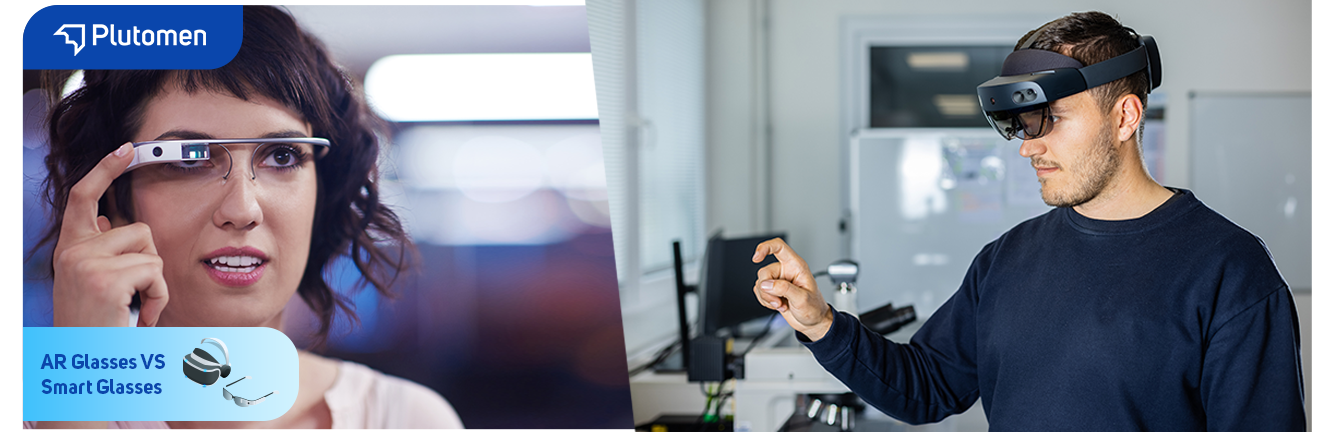
AR technology streamlines maintenance processes by enabling technicians to compare goals and results simultaneously on an AR display. With hands-free operation and remote support capabilities, AR glasses like HoloLens allow technicians to access technical data, virtual models, and step-by-step instructions while performing maintenance tasks. This minimizes downtime, increases maintenance efficiency, and supports effective knowledge transfer. - Collaborative Work:
AR in Industry 4.0 promotes collaborative solutions by facilitating access to expert knowledge. Remote collaboration using AR applications allows experts to guide employees across different locations, reducing the need for on-site expertise. This enhances productivity, facilitates knowledge sharing, and bridges skill gaps, enabling efficient collaboration and training in complex manufacturing environments. - Customer Relations:
AR in Industry 4.0 promotes collaborative solutions by facilitating access to expert knowledge. Remote collaboration using AR applications allows experts to guide employees across different locations, reducing the need for on-site expertise. This enhances productivity, facilitates knowledge sharing, and bridges skill gaps, enabling efficient collaboration and training in complex manufacturing environments. - Quality Assurance:
AR in Industry 4.0 technology supports quality assurance by overlaying virtual models with actual products or components. This allows for real-time comparisons and identification of deviations from manufacturer specifications. Quality control personnel can mark and address these deviations directly in the AR overlay, reducing errors, improving accuracy, and streamlining the quality assurance process. - Production Planning:
AR in Industry 4.0 facilitates better planning of production areas by projecting virtual models of machines, storage areas, and transport routes onto the real environment. This enables pre-commissioning assessments, optimization of layouts, and identification of potential improvements. By visualizing and simulating production processes, AR helps manufacturers optimize efficiency, minimize bottlenecks, and improve overall production planning.
Example of Augmented Reality in Industry 4.0
Augmented Reality for industrial application offers innovative solutions across various sectors in Industry 4.0. Here are some notable examples of AR implementation:
- Toyota Motor Corporation:
Toyota leverages AR applications to simplify the installation and maintenance of production lines and factory buildings worldwide. Through secure tools like Vuforia Chalk, remote assistance is provided, allowing experts to guide technicians in real-time with features like live video, audio, and digital annotations. This reduces travel requirements, enhances communication, and expedites maintenance processes. - BMW Group:
AR technology is employed by the BMW Group to enhance training programs. By overlaying instructional videos and information onto the shop floor environment, employees can easily grasp complex assembly steps. Trainers provide live guidance, answering specific questions beyond the video content. AR training videos not only accelerate learning but also enable simultaneous training of multiple employees, optimizing workforce development. - Škoda:
Škoda initiated a pilot project to explore the diverse applications of AR glasses. These glasses facilitate maintenance optimization by projecting manuals and checklists directly onto technicians’ field of view, allowing them to work hands-free. Furthermore, AR enhances training courses by integrating video conferences, creating an immersive learning experience. The project aims to enhance occupational safety, communication, and streamline maintenance processes. - Volvo Group:
Volvo leverages PTC’s Vuforia tool for AR applications, positioning itself as an innovative employer in the market. Existing employees actively contribute to knowledge transfer by participating in new processes using AR technology. Specifically, AR is employed in quality control and assurance, enabling the collection of expert knowledge and preparing it for junior staff. AR applications also enhance the training of new employees, reducing the learning curve.
These examples demonstrate how Augmented reality for Industry 4 is used for optimizing maintenance procedures, improving training programs, facilitating remote collaboration, and positioning companies as technologically advanced employers. AR empowers businesses by connecting experts remotely, streamlining maintenance activities, accelerating employee skill development, and driving overall operational efficiency in the era of smart manufacturing.
Wrapping Up!
The augmented and virtual reality in manufacturing is driven to increase the development and adoption of better processes and to obtain better results. Various technology companies are working to make these technologies more adaptable and penetrate them more in the manufacturing segment. These technologies are able to bring the change on the factory floor, lets the various stakeholders collaborate from the distance, and interact like never before. The businesses need to seize these opportunities to make their mark or go into the obvious oblivion.
Frequently Asked Questions

Hiren Kanani
CTO, Cofounder of PlutomenWith 10+ years of experience, Hiren Kanani has helped Plutomen ensure smooth communication between the company and its clients for swift project delivery with fewer iterations. He is the CTO and founder of Plutomen.