In a world reshaped by the COVID-19 pandemic, distance has often become the new norm. Digital technologies now make it feasible to collaborate across vast distances, maintaining service continuity and production, even when separated by thousands of kilometers. One of the most transformative applications of these cutting-edge remote technologies is Remote Visual Inspection (RVI), which is being used across numerous industries for critical tasks.
From risk and asset management to industrial maintenance, site inspection, and supply chain auditing, RVI boosts productivity, lowers operational expenses, and enhances both safety and sustainability. Whether in manufacturing, energy, or infrastructure, the impact of RVI is profound.
Impact of COVID-19
The years 2020–2021 were by far the most disruptive for enterprises worldwide. Supply networks were thrown into disarray, and the aftereffects of the pandemic still linger. Many industries are still facing travel restrictions and logistical challenges. For example, the global chip shortage, which began during the pandemic, is still affecting sectors ranging from electronics to automotive manufacturing, with experts predicting the issue could persist into the foreseeable future.
In such circumstances, Remote Visual Inspection (RVI) technology emerged as a critical solution. By allowing quality control and safety inspections to proceed despite restrictions, RVI ensures operational continuity. With companies across the world striving to stay resilient amid economic instability, remote inspection solutions—have played a pivotal role.
What Does Remote Video Inspection (RVI) Mean?
A qualified inspector will often do an in-person examination of a good, service, or job site. Almost every business, from manufacturing to construction, uses inspections. The only difference between a remote inspection and an in-person inspection is that the inspector watches the procedure live on a screen or virtual-enabled view remotely. Another commonly used term with the same idea is virtual inspection.
Reasons to Use Remote Visual Inspection
Various sectors frequently engage in inspection activities. They frequently involve a location or testing and measuring tools. To ascertain whether the site or the equipment is in compliance with predetermined goals, the findings are compared to certain criteria and regulations.
Inspections have traditionally been conducted on-site, but as more businesses use digital tools and technology, the global market for digital inspection is predicted to reach $28.9 billion by 2025, according to the latest Report Linker report. Adopting digital technology can streamline inspections and save money and time.
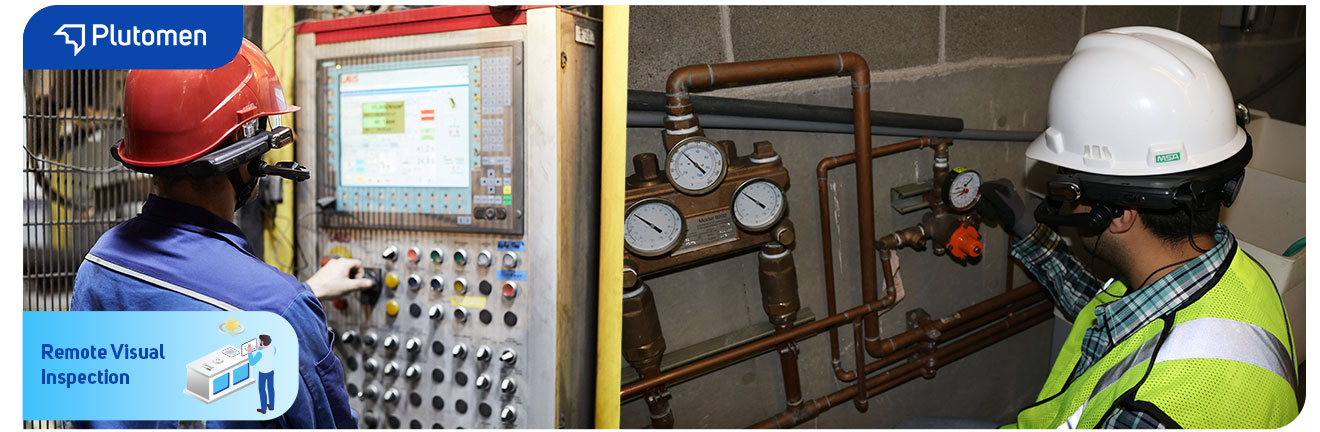
These inspection digitalization solutions include remote visual inspection options. Experts can remotely visually analyze a piece of machinery or a location using remote visual inspection equipment like smartphones, tablets, connected eyewear and headsets, remote cameras, drones, or endoscopes, experts can remotely visually analyze a piece of machinery or a location. This procedure allows for verifying the equipment’s quality and integrity under corporate and industry requirements without leaving the office. In many industries, including manufacturing, automotive, oil & gas, telecom, aerospace, construction, maritime, or energy, remote visual inspection equipment enables employees to work together from thousands of miles away or in difficult-to-reach places or equipment.
Remote Visual Inspection Demo: How Plutomen Connect Works?
Watch the video to learn how Plutomen’s Remote Visual Inspection Software works.
Watch VideoUse Cases for Remote Visual Inspection
Solutions for remote visual inspection go well beyond the straightforward transmission of a video stream. Examples include multi-participant inspections, document sharing, remote HD photo taking, recording, real-time annotations, video pointer guidance, inspection checklists that enable a workflow of inspection points to be followed, defect recognition and characterization, electronic signature, and automatic generation of inspection reports.
Several uses for remote visual assessment are as follows:
Risk and Asset Management
Identifying and assessing the hazards to which an organization is exposed constitutes risk management. Onsite inspection can be used to conduct virtual audits, examine and verify components during production or commissioning, or lessen the risk to personnel when checking hazardous equipment. Companies may retain business continuity while ensuring their assets and goods’ safety and compliance through remote inspections. Additionally, remote inspections facilitate quicker decision-making and reaction times. This use case may impact companies in the oil and gas, maritime, offshore, automotive, construction, pharmaceutical, energy, and other sectors.
Industrial Maintenance
Unexpected equipment malfunctions and downtime can significantly influence a manufacturing line’s expenses and organization. Reduced machine downtime can be achieved with a remote visual inspection. The expert’s remote support of the technician during the inspection can lower the risk of breakdowns by increasing the reliability of preventative checks. It might also be necessary if something goes wrong. After a breakdown, there is a race against time to get a qualified technician to the scene, which may take several days. An on-site technician can receive prompt assistance from a remote specialist who will direct him as he examines the machine or equipment to make a quicker diagnosis.
Remote Audits & Inspections
Assisted Reality is already used for factory commissioning, audit and inspection of the shop floors. And this is not limited to factories; the use case extends to numerous industries. Adequate and timely inspections are critical to fulfilling deadlines and essential to safety and quality management. Architects and civil engineers do build and site inspections daily. Due to the intricacy of specific large projects, the architect must frequently visit the site to address questions as they are raised. According to a recent survey, access issues to the site account for 70% of requests for extensions of delivery deadlines. Using remote visual inspection, bringing together architects, engineers, and other involved parties is superficial and unnecessary.
Supply Chain Inspection
Inspection of the supply chain’s suppliers helps to reduce the cost-effectiveness of defective equipment and ensures that the equipment acquired will fulfil standards. They can include everything from product verification to operational risk. They may be carried out by the business or specialized outside firms. Different specialists’ engagement may be necessary to validate compliance, depending on the product. Suppliers can also be many and spread throughout the globe. Remote visual inspection can be helpful to access several specialists simultaneously and to cut down on travel to various suppliers, whether the process is internal to the company or outsourced.
Remote Visual Inspection’s Advantages
The travel restrictions and distance requirements implemented during the COVID-19 outbreak hastened the implementation of remote visual inspection. Remote inspection has demonstrated its long-term worth to a range of businesses over this time, enabling the continuation of crucial infrastructure projects. It boosts productivity, lowers expenses, and promotes security. The following are a few advantages of adopting remote visual inspection:
Fast decision-making process
Response times are sped up using remote inspection, which also enables multiple team members to participate and receive rapid feedback. Decisions can be made more swiftly in this way.
Enhanced operational effectiveness
More inspections can be finished in the same amount of time by eliminating travel. By lowering the wait time for an inspector to become available, the efficiency gains are also passed on to the consumer.
Increased safety
Fewer workers will be needed on site thanks to remote visual inspection, lowering on-site dangers. Moreover, the inspector need not visit the site physically, avoiding any potentially dangerous environment.
Reduced carbon footprint
Remote video inspections lessen travel to sites, which are frequently distributed across the nation and even globally, which reduces carbon footprint. The number of these visits might be restricted, and virtual inspections could be used to assess a company’s operations.
Ensure business continuity
Inspections can proceed despite access issues or travel limitations at the supplier site. To reduce risk, up the frequency of inspections for clients in remote areas. Reduced fatigue among auditors and inspectors as a result of travel.
Minimum Requirements for Remote Video Inspection
When health and safety regulations threaten business continuity, remote real-time video inspection employing smartphones, tablets, and smart glasses can assist sustaining global supply chains and operating schedules.
- Any internet-connected smartphone or tablet from the modern era. compatible with both iOS and Android.
- For video streaming, Wi-Fi and cellular connections with a minimum bandwidth of 100kb/s are advised. Networks with at least 4G speed should offer performance attributes.
- A personal Internet dongle should be taken into consideration when traveling to isolated areas with poor or no access.
- If working in a noisy area, use headphones for voice audio.
- Although smart glasses will be used on some projects, no additional hardware is necessary.
How Remote Visual Inspection work?
The actual process of remote visual inspection depends upon the business and the problems. Remote visual inspection usually includes someone on-site using remote visual inspection equipment such as smartphone or a tablet to display a professional over a piece of automation or equipment.
Remote Visual Inspection can also be done through:
- Drone Footage- By using drone an expert uses to figure out the appropriate areas. It is suitable for those places which are hard to reach, and it might be dangerous, for example, the roof of the building.
- Remote Cameras- The remote cameras may demonstrate on-site employee precisely what they notice by using cameras that attach remotely to equipment (such as glasses or helmets) or eyepieces.
- Robotic Crawlers- A Robotic crawler is a robot on wheels which controls by an expert to reach an unsecured area. The camera in the robot crawler is on the top so that the expert can check the scene.
- Videoscopes- Videoscope, also known as borescope, endoscope, or fiberscope is has a tiny camera chip on its tip. It is a gracious method for assessing a confined space. It sometimes includes a small illumination source that generates intense light to enhance visibility.
The exact spot of the inspection and the product or area that must be inspected will ultimately determine the best tool for the task in hand.
Brochure: Remote Visual Assistance With AR, Simplified!
Download the Brochure to Learn How Plutomen’s Remote Visual Assistance Solution can help Streamlining Inspections.
Download BrochureHow to Conduct Successful Remote Visual Inspection?
A review that takes place remotely through visual inspection varies from one done in person. Using the procedures underneath, your next remote visual inspection could do smoothly.
Define the compliance requirements
To perform lawfully, a firm must comply with laws, rules, industry standards, and moral behaviour guidelines.
You must be aware of these complying standards to conduct remote visual testing. You can report anything inconsistent if it is.
Test software and hardware beforehand
To make your remote visual inspection run smoothly, you must test your software and hardware. You have to analyse the errors and problems, and this process is done before inspections begin.
There are some highlighters to test before the inspection-
- Check the cameras
- Review the video software features
- Test the internet connection
Conduct the inspection
There is no step-by-step instruction on how to do a remote visual inspection since every inspection is unique.
However, below are the essential procedures for examining the structure of a new house to give you a sense of what happens during an inspection. Here is an illustration of an employee on-site with a helmet-mounted camera-
- The assessor joins the call
- The assessor reviews the job site
- The assessor takes notes and screenshots
- The assessor asks any remaining questions
Review the inspection report
Prepare an inspection report summarizing your findings and recommendations for improvement when inspection is complete.
The following are some recommended written follows keep in mind when you write the report:
- Be clear and brief
- Be unbiased
- Support your findings
- Provide actionable advice
- Review the report before submitting
What to Look For in Remote Visual Inspection Software?
Here are some important characteristics to watch out in remote visual inspection solution:
- Multi-purpose inspection- By involving more than one assessor, you may speed cooperation or gather multiple viewpoints.
- Real-Time Annotations- While doing the inspection, make a mark on the screen for attaining attention to a specific location.
- Document Sharing- Share important details during the inspection, such as representation for the machinery or instructions for deconstruct it.
- Remote Screenshots- To give verification for the inspection report, you have to take screenshots of the estimated essential components.
What is Remote Visual Equipment?
Remote Visual Inspection (RVI) is an approach for visually inspecting an element from far away, requiring hardware and software functions. This secured testing and data collection technique was developed in the 1970s and employed advanced tools to remotely check machines for flaws or damage.
What Is Remote Visual Inspection Equipment and Supplies?
Sometimes it is necessary to use specialised remotely operated equipment, including borescopes, specialised cameras, or robotic equipment when a human cannot physically visit the inspection location. Remote inspection is frequently done when a direct visual inspection cannot be performed.
What Remote Visual Inspection Equipment Are Used Today?
Remote Visual Inspection (RVI) equipment comes in various forms and is widely employed in several sectors today. Examples of Remote Visuals Inspection gear in use include as follows:
- Borescopes- Borescopes are optical instruments that are used to rake pictures or movies within pipelines or other small slots.
- Videoscopes- Videoscopes offer adjustable capabilities for enhanced flexibility in challenging locations as well as real-time video inspection.
- Fiberscopes- When using a fiberscope for inspection areas with bends or curves, light is transmitted via fibre optic technology from the end that is distal to the eyepiece or camera.
- Endoscopes- Endoscopes are flexible tubes containing a light source and camera that are used for industrial and medical inspections.
- Drones- Drones are used to remotely inspect faraway locations while taking high-resolution photos or movies.
- Robotic Crawlers- Robotic Crawlers are used to inspect limited locations and collect visual data.
Summary
It’s past time we surpassed the conventional inspection procedures used on sites. The development of newer technologies leads to ongoing changes in the global economy. All industries should be able to conduct remote video inspection. AR could aid in harm reduction and efficacy maintenance. It might also significantly affect how much money the sector raises.
At Plutomen, we provide a range of cutting-edge augmented reality and assisted reality solutions for diverse industries to provide customers a fantastic experience. Get in touch with our specialists to get a step closer to efficient remote visual inspection.
Frequently Asked Questions

Keyur B
CEO, Founder of PlutomenWith more than 12+ years of experience in the world of enterprises, technology, and metaverse, Keyur Bhalavat is leading Plutomen to gain meaningful partnerships & to have a strong clientele network. He is one of the board members of GESIA (Gujarat IT Association Ahmedabad).