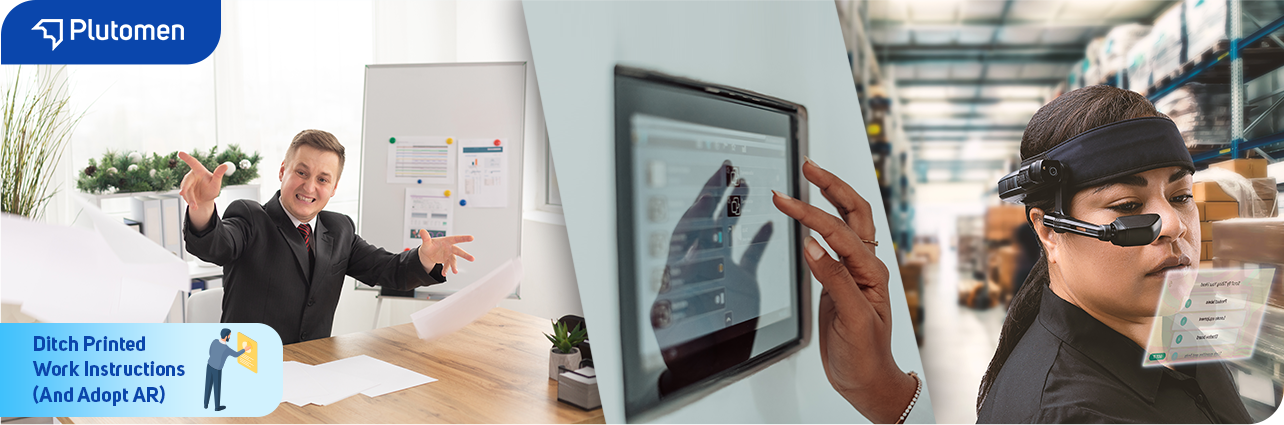
Manufacturing is undergoing a major transformation—becoming faster, digital, and safer at an unprecedented rate.
Of course, making this transition is not easy, but with assistance and training, it is achievable. Transferring knowledge to your workforce is essential. As jobs in the manufacturing industry become more digitized and the global supply chain becomes more complicated, it is time to effectively distribute work and deliver knowledge to your workers.
But before that, ask yourself:
- Do you want to increase your employees’ daily productivity?
- Do you want to smooth out your work instructions for the manufacturing process?
- Do you want to increase the efficiency of your operations?
If the answer to all your questions is Yes, then you are at the right place.
To achieve everything stated above, you need well-defined work instructions for manufacturing and production operations.
In this blog, we will help you understand:
- What are work instructions in manufacturing?
- How to create work instructions in manufacturing?
- What are the examples of manufacturing work instructions?
Let’s start!
Definition of Manufacturing Work Instructions
Manufacturing Work Instructions (MWIs) are detailed guides that direct manufacturing teams on assembling, packaging, labeling, and dispatching products precisely according to specific standards. Essential for minimizing production errors, enhancing quality, and ensuring customer satisfaction, MWIs play a pivotal role in preventing costly rework and scrap.
What are Manufacturing Work Instructions?
Every business process, operation, and procedure needs a set of instructions to work seamlessly. However, when it comes to manufacturing work instructions, they are a bit unique by nature and different for various industries.
These work instructions are interactive, have visuals to transform information effortlessly, and are user-friendly so that industrial workers can use them with ease. They impart knowledge to all your frontline workers and ensure a quality threshold for mass production.
However, what is the clear purpose of manufacturing work instructions?
The purpose of manufacturing work instructions is to aid your enterprise’s production process for quality products. They provide step-by-step guidance, ensuring compliance with manufacturer instructions to maintain consistency and precision in every production cycle.
While there are many things you must consider in detail while creating your work instructions, you should adhere to:
- The safety and training of your workforce are your biggest assets.
- The seamless operations flow of your smart factory with periodic and predictive maintenance of complex machinery and equipment.
- The final product should match the standardized guidelines set by industry experts, leaders, and the government.
But two more factors make work instructions important for the manufacturing industry. These are:
- Continuous improvement in your manufacturing cycle and work instructions to aid frontline workers
- Eliminating the waste of time, resources, money, and labor on unnecessary practices.
To put it together, manufacturing work instructions are all about the standardization of rules and resources to get quality output. Often, we have seen too many manufacturers producing the same product, but it is the quality that counts. A quality product will be a hero among the masses and will give your enterprise a better reputation in the market. Thus, you must emphasize the standardization of your work instructions.
By providing to-the-point work instructions to your workers, you can achieve:
- Continuously improving processes
- Increasing operational efficiency and safety
- Reducing machine downtime and equipment changeover time
- Effective training procedures
- Getting a more motivated workforce in return
Now, you must be curious to know what’s included in work instructions. Let’s learn about it in our next section.
[Ebook] Augmented Reality Applications On Factory Floor
Discover various ways Augmented Reality can help revamping factory floor operations.
Download EbookKey Elements of Manufacturing Work Instructions!
The primary purpose of manufacturing and production work instructions is to support the production process and ensure high-quality output. So, your work instruction for production should be easy to understand and should not include a lot of deviations. However, working in the manufacturing industry can call out for many unpredictable challenges.
For example, a shortage of certain raw materials for mass production or the absence of a supervisor from the assembly line. This can put your manufacturing on hold and lead to downtimes.
Fortunately, the manufacturing work instructions guide created by your supervisors, internal teams, and other industry experts already includes contingency plans to follow through.
However, the main framework of your work instructions includes:
1. Best Practices
Your work instructions should always be updated with the latest safety and standardization requirements. These guidelines can vary from one production line to another, but certain specific rules will be the same like safety precautions and they should be followed religiously.
2. HD Visuals
Since visual work instructions, digitized SOPs, paperless guides, and manuals are a big part of smart factory, so make sure that all your visuals are in HD format. They should include all the microinstructions for your frontline workers so that they can produce quality products. Not just that they will also simplify the process for workers to follow through and increase their engagement too.
3. Interactive Elements
These interactive elements will include all the minor details that a worker needs while solving a particular issue. It is like a supervisor’s aid that will help workers to solve their errors. Your workers are bound to make errors, especially the ones who are newly hired. Thus, your work instructions guide should include elements that can help them fix those errors without much hassle.
Also, good manufacturing work instructions take time to develop and follow through. Thus, take your time and work on it.

We are pretty sure, that now you are curious about how to create these work instructions in manufacturing. Thus, in our next section, we will discuss “how do you create work instructions in manufacturing?”
Steps to Create Work Instructions in Manufacturing
Many enterprises create manufacturing work instructions either from scratch or through a well-defined template. One tip we would recommend is to create digital work instructions so that frontline workers can access them via computer, mobile, or other wearable electronic devices.
The step-by-step visual instructions and elements will provide a better approach and experience for your frontline workers. Also, the well-defined structure of these work instructions is very important. It helps in keeping instructions:
- Task-oriented
- User-centric
- Easy-to-understand
- Available Instantly
These steps are used by manufacturers to continuously improve, optimize, and sustain processes and to maximize the value of their manufacturing units.
Here are the steps to creating manufacturing work instructions:
Step 1: Write a clear title
Specify the goal of the work instruction with a crystal-clear title so that your frontline workers know whether it pertains to them or not. Do not forget to mention the procedure you are about to use.
Step 2: Design the steps to reach the goal
Once you have specified your goal, start working on designing your steps. Create a detailed design for every step as it will help your workers be familiar with the context of the task. It will also help them understand their roles and responsibilities to complete a particular task. While designing your steps, you will emphasize controlling the quality of your product and increasing the productivity of your employees.
Step 3: Add clear visuals to your step
Ensure that you lay complete instructions for your workers with HD visual elements like images, videos, charts, and 3D annotations in case of complex machines. Clear, concise, and easy-to-follow instructions will help your workers eliminate root causes and enhance your performance.
Step 4: Add a short snippet of action-oriented text
Visual elements make your work instructions more engaging and interactive. A short snippet of the action-oriented task will only guide them and state whether they are on the right track or not.
Step 5: Edit and format your instructions
Once you have written your instructions, make sure to edit and format your template. Use heading tags to make the title and subtitle easy to read. The instructions should be sequential. Also, while creating instructions, ensure that you use visual elements and images so that your worker can easily understand them.
Step 6: Validate the information
You can accomplish this step by reaching out to experienced supervisors, employees, stakeholders, and experts who know how each department operates. They will share their thought process, give you advice, and confirm whether you are on the right track or not.
Step 7: Re-write & Simplify your instructions
The first draft will always lack something. That is why, after you have got your document validated by an expert, it’s time to rewrite and simplify it. Through this, you will be able to integrate expert alteration in your instructions
Step 8: Save and Share
Once you are done drafting and revising your work instructions, you can save them and share them with your frontline workers, operators, and other technicians.
Now that you know how to create work instructions in manufacturing for your enterprise, let’s move on to our next section.
In the next section, we will quote a few work instruction examples from manufacturing.
Evolution of Work Instructions to Digital Platforms
The advent of Industry 4.0 has brought significant transformations to work instructions in the manufacturing industry, transitioning from traditional paper binders to digital platforms. With the rise of the Smart Factory, work instructions have evolved into interactive software applications. This digitalization enables greater flexibility, improved efficiency, and enhanced collaboration among workers. Furthermore, the integration of Internet of Things (IoT) technology has revolutionized work instructions by connecting them directly to machinery. This integration enhances safety measures and precision, as real-time data from the machinery can be seamlessly incorporated into the work instructions, providing operators with accurate training and facilitating proactive maintenance. This evolution of work instructions to digital platforms reflects the ongoing drive for automation, connectivity, and optimization within the manufacturing sector.
3 Manufacturing Work Instructions Industry Examples!
Think through the chaos of a first day at work for your newly-hired employee in the middle of your production floor. With targets to keep up with schedule and quality, the traditional onboarding and training could be better.
This is where well-structured, interactive, and visually enriched work instructions come in to create magic.
For freshly hired frontline workers, these step-by-step work instructions for the manufacturing industry become a lifeline, and regardless of their experience level, these instructions provide efficiency, accuracy, and precision in completing a job at the experience level in their routine operations.
Below are some examples of step-by-step work instructions for different manufacturing industries; let’s dive deeper!
1. Automotive Industry Work Instruction – Paint Quality Control:
Scenario: Final inspection of painted car body panels for defects before assembly.
Work Instruction Style: Digital checklist with image references.
Step-by-Step Instructions:
- Equipment: Provide a list of required tools (measuring gauges, magnifying glass, flashlights) and personal protective equipment (PPE).
- Lighting: Ensure consistent and adequate lighting throughout the inspection area.
- Cleaning: Verify the panel is clean and free of dust, debris, or fingerprints.
- Visual Inspection:
- Checklist: Use a digital list with high-resolution images showcasing examples of acceptable and unacceptable defects (chipping, scratches, orange peel, color mismatch).
- Methodical Approach: Systematically inspect the entire panel, following a defined path (e.g., top-down, left-to-right).
- Measurement: Utilize gauges to verify paint thickness and identify deviations from specified tolerances.
- Defect Recording:
- Digital System: Use a mobile app or tablet to photograph and document any identified defects, capturing location, type, and severity.
- Clear Communication: Mark defective areas on the panel for further action by repair personnel.
- Reporting: Submit inspection data electronically to analyze and track quality trends.
Benefits of Using Automotive Work Instructions:
- Reduced rework: Early detection of defects minimizes costly repainting and delays.
- Improved quality: Ensures finished vehicles meet aesthetic and durability standards.
- Data-driven insights: Facilitates continuous improvement of painting processes
2. Pharmaceutical Industry – Medicine Batch Mixing:
Scenario: Mixing active ingredients for a new medication according to a specific recipe.
Work Instruction Style: Digital work instructions with real-time data monitoring and safety alerts.
Step-by-Step Instructions:
- Preparation:
- Review recipe: Thoroughly review the digital recipe, verifying ingredients, quantities, and mixing order.
- Equipment checks: Ensure all mixing equipment is clean, calibrated, and functioning correctly.
- PPE: Wear required PPE, including gloves, goggles, and respirator (depending on ingredients).
- Ingredient Weighing:
- Digital scales: Use calibrated digital scales to weigh each ingredient per the recipe accurately.
- Barcode scanning: Utilize barcode scanners to verify ingredient identity and prevent mix-ups.
- Real-time monitoring: Track ingredient weights digitally and receive alerts for deviations.
- Mixing Process:
- Follow instructions: Adhere to the specified mixing sequence and speed using digital guidance.
- Temperature control: Monitor and maintain the required mixing temperature using digital sensors and displays.
- Data recording: Log key process parameters (time, temperature, mixing speed) electronically for traceability.
- Quality Control:
- Sampling: Collect samples at designated points and perform specified quality control tests.
- Digital testing: Utilize handheld instruments with digital data recording for faster and more accurate analysis.
- Release approval: Release the batch only after all quality control tests meet predefined criteria.
Benefits of using Pharmaceutical Work Instructions:
- Reduced process deviations: Real-time monitoring ensures adherence to critical parameters.
- Improved product consistency: Digital recordkeeping guarantees batch-to-batch consistency.
- Enhanced product safety: Automated alerts prevent errors and safeguard product quality.
3. Food Processing Industry – Hygiene Standards:
Scenario: Maintaining hygiene protocols in a fruit processing unit.
Work Instruction Style: Interactive training modules with quizzes and visual demonstrations.
Step-by-Step Instructions:
- Induction Training:
- Interactive modules: New employees complete online modules covering hygiene principles, handwashing procedures, and sanitation protocols.
- Quizzes: Assess understanding of crucial hygiene practices through interactive quizzes.
- Practical demonstrations: Observe and practice proper handwashing and equipment sanitization techniques under supervision.
- Daily Routines:
- Visual reminders: Post clear, concise signage throughout the facility outlining critical hygiene practices.
- Digital checklists: Use mobile apps with checklists for daily cleaning and sanitation tasks, ensuring thorough coverage.
- Temperature monitoring: Monitor and record refrigerator and freezer temperatures to maintain food safety.
- Audits and Feedback:
- Regular audits: Conduct regular hygiene audits to identify areas for improvement and ensure compliance.
- Feedback and training: Provide individual feedback and refresher training based on audit findings.
- Continuous improvement: Review and update hygiene protocols based on best practices and regulatory changes.
Benefits of Using Food Processing Work Instructions:
- Reduced Foodborne Illness: Hygiene training reduces contamination and foodborne illness in food processing.
- Enhanced Food Quality: Strict hygiene extends product shelf life and improves quality in processing.
- Improved Brand Reputation: Rigorous safety standards enhance brand reputation and consumer trust.
As we’ve gone through the manufacturing instructions examples, from the intricate layers of automotive paint quality control to the critical precision in pharmaceutical mixing processes and the paramount importance of hygiene in food processing, it’s evident that the digital transformation of work instructions is not just a trend but a necessity in today’s fast-paced manufacturing landscape. According to a McKinsey analysis, digital transformation in manufacturing increases labor productivity by 15% to 30%, demonstrating its significant impact on efficiency and workforce performance.
These manufacturing work instructions examples show how important work instructions are in different manufacturing areas. They help reduce mistakes, improve product quality, and make manufacturing processes more efficient.
Conclusion
Clear, well-documented instructions ensure that the frontline workforce can operate efficiently, reduce errors, and maintain high-quality standards.
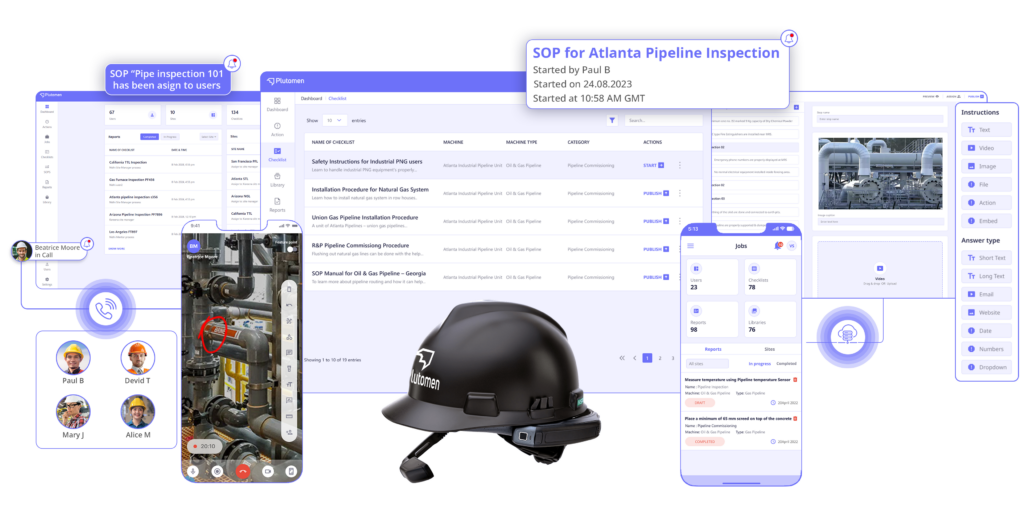
By digitizing work instructions, manufacturers can enhance workers’ productivity, improve workforce training, and minimize downtime. Plutomen Workflow enables organizations to streamline their operations with interactive digital work instructions, and real-time collaboration with experts.
Start your journey toward smarter manufacturing today with Plutomen!
Create Concise, Easy-to-read Manufacturing Work Instructions
Plutomen Workflow is the work instructions software used by 100s of OEMs to create manufacturing work instructions. Request a demo today!
Request DemoFrequently Asked Questions

Hiren Kanani
CTO, Cofounder of PlutomenWith 10+ years of experience, Hiren Kanani has helped Plutomen ensure smooth communication between the company and its clients for swift project delivery with fewer iterations. He is the CTO and founder of Plutomen.