Are you aware that Boeing, the Aircraft manufacturer, implemented the Lean Six Sigma Principles in its operations?
Here’s what happened: The integration of this methodology contributed a lot to making Boeing the largest aircraft manufacturer in the world! The company has reached excellence in its operations, starting with the lean manufacturing process and eventually executing the Six Sigma Principles. They witness the scientifically curated Lean Six Sigma method, which works wonders for front-line operations.
From eliminating waste in the finest ways possible to reducing errors, Lean Six Sigma Principles optimize the process, maximize the productivity of your frontline workers, and give you a refined product with null defects. The fine-tuned methodology, also known as LSS, rules the world. Let’s understand how you can start your LSS journey.
Understanding Lean Six Sigma
You won’t believe it, but Lean Six Sigma is adopted by 82% of the top 100 Fortune companies. From Amazon worldwide to Tata Steel in India to Bank of America, they use lean six sigma for their business operations!
Invented by two companies in different years, Lean and Sigma are other concepts that have gradually become one. They give impeccable results and maximize the company’s productivity.
Lean focuses on reducing waste, whereas Six Sigma stresses minimizing product defects through standardized operations. Lean was introduced first in the 1900s, and Six Sigma methodology became prevalent in the 1980s. Motorola engineers invented it in the 1980s in response to the Japanese way of manufacturing products. It promises a systematic and data-driven framework for empowering employees to yield optimal results.
The first part, Lean, is a methodology for reducing waste with a people-first perspective; on the contrary, Six Sigma comprises five steps and five sigmas—Define, Measure, Analyze, Improve, and Control. Together, Lean Six Sigma works towards a hybrid result, reducing process variations and waste.
The Role of Work Instructions in Operational Excellence
It is said that communication is the key to success. Standard work instructions play a vital role if a company is aligned toward creating excellence in operations. Companies should provide clear, concise, and standardized guidance to frontline workers or ground operators on how specific tasks should be performed. Providing top-notch work instructions to employees is well accomplished with the Lean Six Sigma principles; let us know its incredible synergy.
The Synergy of Lean Six Sigma and Work Instructions
Enhancing Work Instructions with Lean Six Sigma
The best thing about Lean Six Sigma is its various tools that help improve work instructions. From Kaizen to Process Mapping to 5S, with Lean Six Sigma, there is a guarantee of clear communication, practical training of new employees, and upskilling of the old ones. If you want to train your new workers in the industrial field, check this blueprint; it will help retain top talent in the competitive world.
A manufacturing company adopting the 5S Lean Six Sigma principles saw a 20% reduction in waste. Through Kaizen, they identified and eliminated non-value-added activities, resulting in a 15% increase in productivity. Moreover, the standardized work instructions ensured consistent task execution, reducing errors by 30%.
Are you giving thought to creating a work instructions manual? If we have it ready for you.
In your work instructions manual, let’s explore other benefits of embracing the lean Six Sigma methodology.
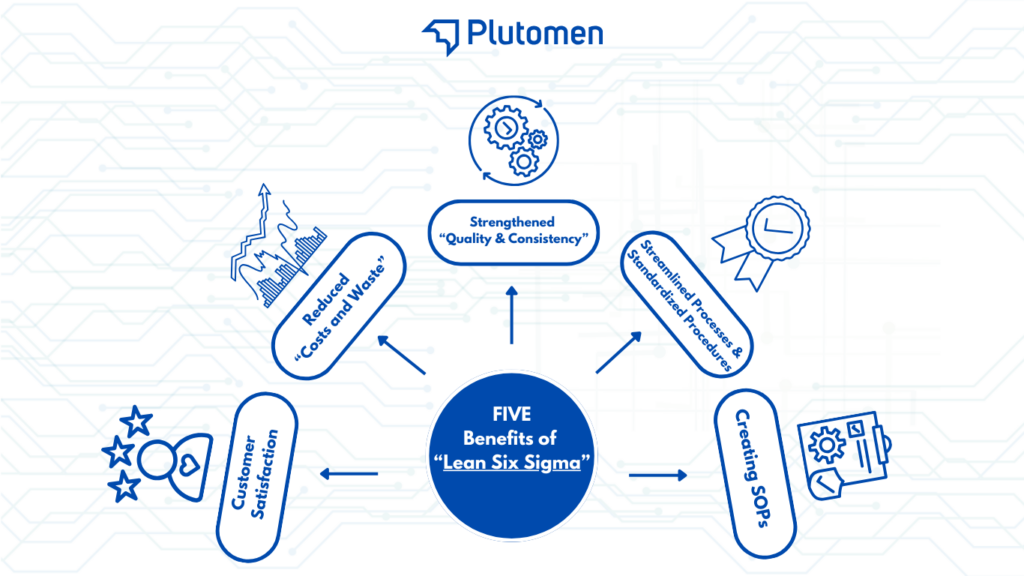
Benefits of Integrating Lean Six Sigma
Indeed, Lean Six Sigma is a powerful way to achieve operational excellence. But the benefits it offers are even more powerful. Lead on
Enhanced Customer Satisfaction
- You have good news if your company’s focal point is the Customer. The whole LSS concept is based on customer centricity, which emphasizes customers’ needs and requirements. Designing a process that meets or exceeds customer expectations, you help them become loyal customers.
Reduced costs and waste
- Lean Six Sigma aims to reduce waste and the cost of manufacturing. Organizations can significantly reduce costs by eliminating rework, defects, and overproduction, improving profitability.
Strengthened Quality and Consistency
- One thing that majorly defines the LSS principle is their draw to the attention of quality & consistency. Six Sigma was created through statistical means, and its methods are also based on statistics-driven solutions. Organizations can achieve consistent product and service quality by implementing statistical techniques and process controls.
Streamlined processes and standardized procedures
- If you have seen the movie, ‘The Founder’, showing the history of how McDonald’s operated as a small diner, then you are well aware of what we mean. Even if you have had the chance to see McDonald’s kitchen, you know what we are talking about. It is one of the most successful food chain brands in the world, and the success behind it is its excellently streamlined front-end and back-end processes, combining an excellent Lean Six Sigma & Kanban. Results? Their wait time is super low. What are the costs? Completely reduced, and customer satisfaction – entirely on point!
Creating Standardized Operating Procedures (SOPs)
- Whether you have new employees joining next month or want to upskill the old ones, LSS promotes documenting your entire operation procedures well. This ensures consistent task execution, reduces variability, improves overall performance and compliance, and leaves no scope for any frontline worker to go wrong or blunder. Instead, it will only increase your frontline worker’s productivity.
Along with the above benefits, Lean Six Sigma undoubtedly has more to it, and that’s the reason it is a rulebook for top-class companies worldwide.
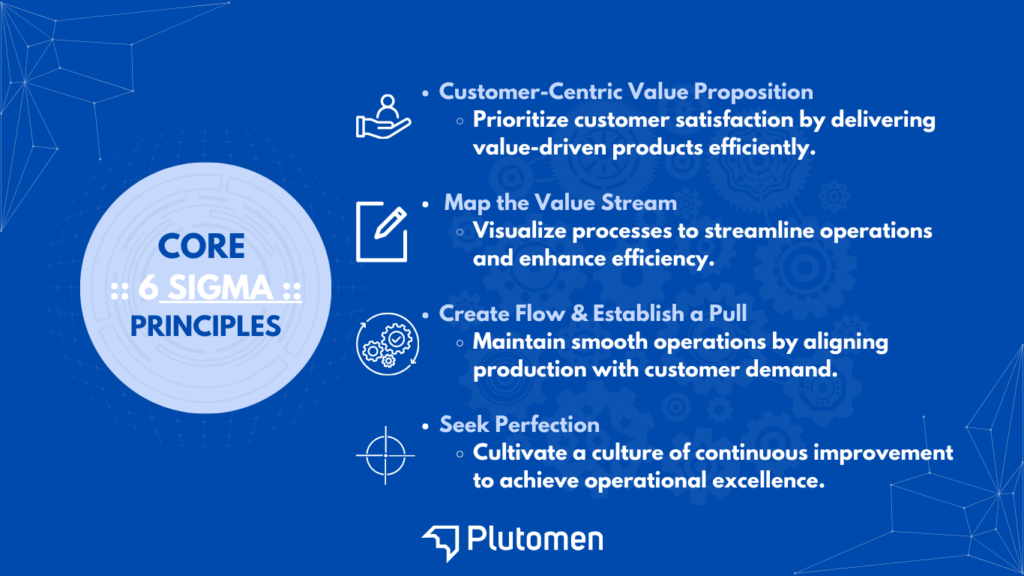
Core Lean Six Sigma Principles for Work Instructions
Through this Lean Six Sigma article, we have come so far in understanding Lean Six Sigma, its benefits, and the companies that use it. Now, it’s time to understand the core principles that define Lean Six Sigma for Work Instructions. Organizations can gain a competitive advantage in today’s fast-paced business environment by eliminating waste, reducing errors, and improving efficiency. So, are you all set to make your business competitive with the LLS method?
Define Value from the Customer’s Perspective
Customers hold the utmost value in any organization, and Lean Six Sigma helps you leverage your methodologies to provide the utmost value to your customers with minimum effort and costs. In LSS, the lean value focuses more on the benefits the customers will receive using your products. The main goal remains to provide value-based products and services that customers value and that make them ready to spend on your product.
Map the Value Stream
Visuals help us understand better; they become a definite guide in the overall process. In the epoch of advanced technologies, you can do it amazingly with 3D work instructions and a value-stream visual guide. Mapping the value stream or Value stream mapping is a big thing in Lean manufacturing. It is a visual guide that shows the entire process from point A to point B with all the necessary elements and components.
Take the example of Toyota; they are not only excellent in quality, but their cars are also known for delivering faster. This is because of their super-excellent operational process, which comes from mapping the value stream. Check the Toyota Production System; it is no doubt why they are still leading the market even though they started in the 1930s.
Create Flow and Establish a Pull
Flow and Pull are one of the primary principles of the Lean Six Sigma Method. As simple as the concept of flow and pull sounds, it is hard for any regular organization to maintain – poor, unmaintained flow in any company results in wastage and non-valuable activities. Considering the paint point, Lean Six Sigma helps generate a proper flow and establishes a pull from the customer’s side. Beckett & Simonon, a shoe company, has effectively utilized this method and only manufactures shoes when there is a pull, and through their Lean-based manufacturing site, they create a flow.
If you are also a business based on manufacturing, go ahead and read this manufacturing work instruction. It will help you improve manufacturing operations and minimize the cost of running these expensive production operations with fewer errors for your manufacturing unit.
Seek Perfection
When your process is structured, the result is perfection. Lean Six Sigma in Work Instructions enables an environment that helps you seek perfection, from continuous employee engagement to ensuring customer satisfaction. Communicating with your team and creating a space for constant improvement will create a culture of change and flexibility for perfection.
Implementing Lean Six Sigma in Work Instructions
Now that you have fully understood Lean Six Sigma, it’s high time you knew the implementation technique. As mentioned, earS comprises the DMAIC – 5 sigmas – Define, Measure, Analyze, Improve, and Control. What next, taking one step at a time, head on and implement?
Define
- Define your problems, ultimate goals, and how to increase customer value. This is the first step in building purpose and getting going.
Measure
- It includes data about where you are and where you want to be. Typically, it is the most extended phase in LSS, but it is beneficial in the long run.
Analyze
- The measure phase helps you get the data, and the analysis phase in Lean manufacturing is about scrutinizing where the root problem is and where you are lagging and gradually mapping the solution.
Improve
- After you know where to focus, there is time for improvement. Solve the problem with adequate solutions; the fourth stage is about improvising.
Control
- The last and final stage involves a properly structured, carefully monitored plan to guarantee fresh progress and further achievements. Simply put, the stage is about ensuring you maintain the current level of your progress,
So, there we conclude.
Key Takeaways of Lean Six Sigma!
All the above Lean Six Sigma Principles are carefully curated by engineers from their years of experience, and it all depends on how soon you want to implement them to improve your processes and achieve your goals.
But some things are sure: by implementing Lean Six Sigma methods, you get:
✅Enhanced work instructions
✅Waste elimination
✅Reduction in errors
✅Improved company efficiency
So, happy Lean Six Sigmying for your OPERATIONAL success!
Frequently Asked Questions

Keyur B
CEO, Founder of PlutomenWith more than 12+ years of experience in the world of enterprises, technology, and metaverse, Keyur Bhalavat is leading Plutomen to gain meaningful partnerships & to have a strong clientele network. He is one of the board members of GESIA (Gujarat IT Association Ahmedabad).