![5 Major Challenges of Mining Industry [2026 Edition]](https://pluto-men.com/wp-content/uploads/2025/12/minimg-01-1.png)
The mining industry is essential to the world’s manufacturing, production of energy, and infrastructure. Yet, despite its significance, the mining sector still faces the ongoing workforce, safety, and operational challenges that affect productivity and profitability. In 2026, these challenges are being further intensified by stricter ESG requirements, aging workforces, and the need for digital transformation.
In this blog, we explore the key challenges faced by the mining industry today and how modern, connected technologies are helping organizations address them.
5 Major Challenges Impacting Mining Operations
Mining operations are complex, asset-intensive, and often spread across remote and harsh environments. These circumstances worsen existing mining sector issues, making it more challenging to maintain consistency, visibility, and control all throughout daily operations.
Below are the most common challenges in the mining industry that organizations continue to struggle with.
1. Safety Risks and Hazardous Working Conditions
Safety is one of the most serious mining industry problems.
Miners face significant risks while working with heavy equipment, restricted spaces, explosives, dust, and severe temperatures.
Despite improvements in safety protocols, the lack of real-time visibility and delayed response continues to put frontline workers at risk.
Why this is a growing challenge
- Manual inspections increase exposure to hazards
- Safety instructions are often undocumented or inconsistent
- Emergency response is slow in remote sites
Even with strict laws, many problems in the mining sector arise from inadequate documentation, missing inspections, or a lack of real-time visibility into field conditions.
In this kind of situation, digital work instructions, real-time visual support reduce on-site exposure while improving decision-making.
2. Skilled Labor Shortage and Knowledge Loss
Next comes the growing shortage of skilled workers. As experienced miners retire, mining industries struggle to:
- Train new workers quickly
- Retain operational knowledge
- Maintain productivity across sites
Providing training with the old traditional methods is time-consuming and often ineffective for complex mining operations.
Why this matters
- Loss of tribal knowledge impacts productivity
- Longer onboarding time for new miners
- Inconsistent task execution
This has become one of the most significant problems in the mining sector, particularly in operations that rely heavily on manual procedures and tribal knowledge. Industries need to transform frontline workers into knowledge workers.
3. Operational Inefficiencies and Poor Visibility
Many mining operations still use printed work instructions, spreadsheets, or manual data collection. This causes significant mining problems, such as a lack of transparency, missing data, and slow decision-making.
Common operational challenges
- No real-time visibility into daily activities
- Delayed reporting of equipment or safety issues
- Limited collaboration between field personnel and management.
Without timely data, leaders find it difficult to solve problems before they worsen.
4. Equipment Downtime and Maintenance Challenges
Unplanned equipment downtime is one of the most expensive challenges of mining. When critical machinery fails and production halts, schedules slip, and expenses surge.
Why downtime is common
- Reactive maintenance practices
- Missed inspections
- Delayed issue reporting from the field
These maintenance issues in the mining sector have significant impacts on output and profitability.
5. Sustainability and Environmental Responsibility
From land degradation and water contamination to rising energy consumption, sustainability has become one of the most complex challenges in the mining industry.
Mining companies are under increasing pressure to:
- Reduce the impact on the environment
- Increase energy efficiency
- Keep track of emissions and waste
- Comply with ESG rules
However, many sustainability efforts fail due to poor data collection and a lack of real-time visibility at the operational level.
6. Remote Locations and Limited Expert Availability
Many mining sites are located in remote or hard-to-access areas, making it difficult to:
-
- Deploy experts on time
-
- Resolve equipment issues quickly
-
- Provide continuous support to field workers
Travel delays often increase downtime and operational costs.
How this affects operations
-
- Delayed troubleshooting
-
- Increased dependency on local skill levels
-
- Higher operational expenses
Remote visual assistance enables frontline workers to connect with experts instantly, reducing downtime and travel costs.
Addressing Mining Industry Challenges with Connected Worker Solutions
Plutomen’s connected worker platform helps mining organizations tackle these challenges by digitizing and connecting frontline work.
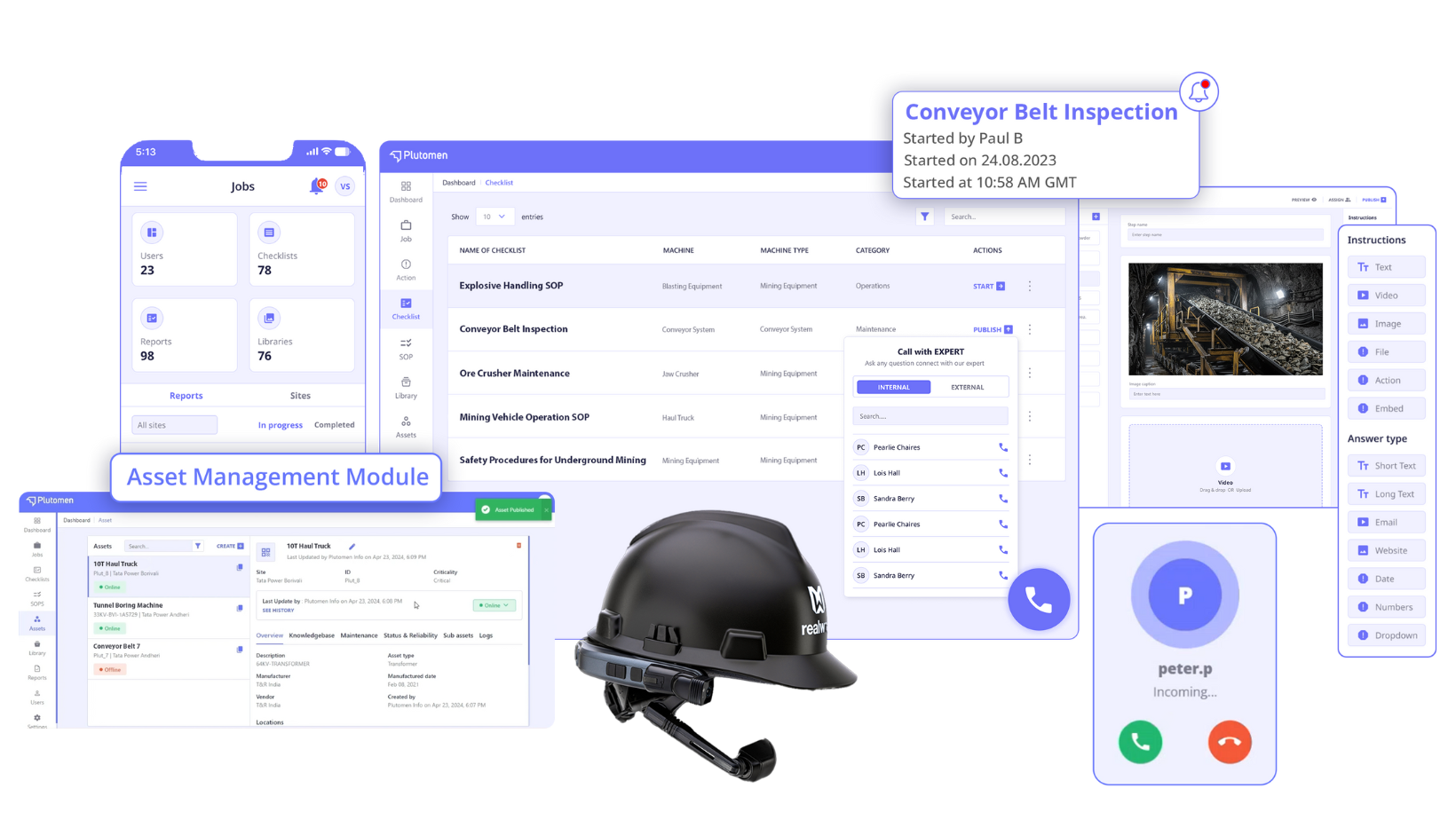
Connected worker solutions help by:
- Digitizing frontline workflows such as inspections, safety checks, and maintenance tasks.
- Providing step-by-step digital work instructions for complex mining tasks
- Enabling real-time communication between miners, supervisors, and experts
- Preserving workforce knowledge with digital work instructions and guided procedures
- Bridging skill gaps and accelerating onboarding for new miners
- Standardizing preventive and condition-based maintenance inspections
- Supporting offline data capture in remote and underground mining locations
Connected frontline workflows can improve productivity by up to 20%, while digital inspections can improve maintenance compliance by 25–40%.
These outcomes directly address the most common mining industry problems.
Why Digital Transformation Is Critical for the Future of Mining
Safety, frontline productivity, and sustainability all depend on how effectively frontline work is managed.
Mining organizations that invest in connected, digital-first solutions like a connected worker platform are better positioned to:
- Reduce operational risks
- Improve miner safety
- Meet sustainability goals
- Stay competitive in a rapidly evolving industry
Mining challenges are evolving. Your operations should too.
Digitize safety, maintenance, and sustainability workflows with Plutomen.
Request a DemoFrequently Asked Questions

Hiren Kanani
CTO, Cofounder of PlutomenWith 10+ years of experience, Hiren Kanani has helped Plutomen ensure smooth communication between the company and its clients for swift project delivery with fewer iterations. He is the CTO and founder of Plutomen.