
Keyur B

Keyur B

February 17, 2025 11 minutes to read Updated On : February 18, 2025

What are Work Instructions: Definition & Use Cases

What are Work Instructions: Definition & Use Cases


Have you ever wondered how the wrong work instruction type can derail your operations?

“In the quest for operational excellence, the clarity and appropriateness of work instructions are not just beneficial – they’re essential.”

Misalignments between tasks and their guiding instructions can lead to:

  • Quality Compromise: Incorrect instructions can lead to subpar product quality.
  • Safety Risks: Missteps in safety protocols endanger employees.
  • Productivity Loss: Inefficiencies waste time and resources

In this article, you will see different work instructions, spotlighting why they matter and how they fit into various work situations. Aligning your tasks with the proper instructions streamlines efficiency and safeguards operations, ensuring the highest quality. Dive into the essentials of selecting and implementing the correct work instructions – your blueprint to operational excellence awaits.

What Are Work Instructions?

Work instructions serve as meticulously crafted guides in document form or digital formats, offering employees crystal-clear, straightforward directions for carrying out particular tasks or procedures. These work instructions are not just simple tasks in steps; these instructions break down complex processes into clear, actionable, in-depth steps, ensuring accuracy in every task.

What are Work Instructions

The Role in Organizational Efficiency

Work instructions are the backbone of operational efficiency. These guidelines serve as an essential navigator, steering front-line workers towards precisely completing a wide range of technical and non-technical tasks. When employees access well-designed work instructions, several critical efficiency aspects are achieved:

  • Consistency: Standardized tasks maintain quality across the organization.
  • Reduced Learning Curve: Clear instructions minimize training time and errors.
  • Time Savings: Work instructions streamline workflows, saving time.

The Impact on Safety

Safety is paramount; work instructions are crucial to its assurance. Appropriately crafted work instructions can significantly reduce the risk of accidents and injuries by:

  • Clarity: Clear safety guidelines reduce the risk of accidents.
  • Compliance: Work instructions ensure adherence to safety protocols.
  • Risk Mitigation: They help organizations proactively address safety hazards.

Productivity and Error Reduction

The implications of well-designed work instructions, particularly the benefits of digital work instructions, ripple through productivity and error reduction. With clear, digital instructions, employees work more confidently and faster and benefit from precision, which minimizes costly mistakes and saves both time and resources.

  • Increased Efficiency: Employees work confidently and faster with clear instructions.
  • Error Minimization: Precision minimizes costly mistakes, saving time and resources.

7+ Types of Work Instructions

In the following segments, we will thoroughly examine diverse work instructions, detailing their definitions, practical uses, and instances from actual scenarios.

Lean Work Instructions

Lean Work Instructions, integral to Lean methodologies, are strategically developed to elevate efficiency through waste reduction and productivity augmentation. Incorporating this method in manufacturing streamlines everything. Precision and ditching waste are non-negotiable for peak automotive, aerospace, and healthcare performance.

  • Use Case: Consider an electronics manufacturing facility implementing Lean Work Instructions. Workers can consistently produce high-quality products with minimal material waste by providing detailed step-by-step manufacturing work instructions for assembling circuit boards. Performing manufacturing tasks considering these tactics increases the overall efficiency of frontline workers. Implementing lean work instructions(LWI) reduces manufacturing workers’ errors, making it less expensive for different industries and making the customers of these industries’ businesses happier.

To deepen your understanding of the principles that drive Lean success and how they can be applied to work instructions, we recommend a pivotal resource from MIT Sloan. “Setting the Record Straight on Lean” offers insights into the essence of Lean methodologies, clarifying how they can significantly enhance operational efficiency and productivity.

Dive into the details here: Setting the Record Straight on Lean.

Quality Work Instructions

Clear quality instructions are vital in maintaining high standards and delivering consistent results. They are essential in many industries, especially for ensuring quality control.

  • Use Case: Imagine a pharmaceutical company producing life-saving medications. Quality Work Instructions meticulously detail the manufacturing and quality assurance processes, ensuring that each step, from ingredient sourcing to final packaging, adheres to strict pharmaceutical regulations. Implementing quality work instructions(QWI) for a business can guarantee the safety and effectiveness of its products, maintaining its reputation for quality and compliance.

Safety Work Instructions

Safety Work Instructions are paramount in ensuring workplace safety and preventing accidents. “In high-risk industries, safety work instructions are indispensable. For frontline workers, these step-by-step safety instructions offer direct, easy-to-understand guidance to ensure their well-being and avoid dangerous situations. Crafted from the ground up, these instructions are the backbone of our commitment to safety, enabling every team member to navigate their tasks confidently.”

  • Importance in Preventing Workplace Accidents: Safety Work Instructions are the first defense against workplace accidents. So these instructions precisely detail safety protocols & procedures, ensuring frontline workers understand the safety guidelines. Having clarity is essential when life is at risk. Also, these work instructions help build a safety-first culture, significantly reducing the risk of accidents and injuries. So, it can create a safe working environment through these safety work instructions,
  • Examples in High-Risk Industries: In industries like construction, oil and gas, and chemical manufacturing, where the potential for accidents is high, Safety Work Instructions are indispensable. That’s one reason why adopting AR-enhanced work instructions is becoming indispensable. They provide comprehensive guidance on operating equipment, handling hazardous materials, and executing emergency response protocols.  A work instructions example in a chemical manufacturing facility would be a detailed guide on the safe handling and disposal of toxic substances, ensuring compliance with safety regulations and minimizing the risk of chemical exposure incidents.

Use Case: Consider a construction site where Safety Work Instructions are in place – having defined instructions for specific safety practices for various tasks, including efficient work, heavy equipment operation, and electrical gear handling. So workers can closely follow the protocols, leading to significantly lower accident rates and ensuring that safety is paramount and construction crews return home safely after their shift.

Assembly Work Instructions

Having step-by-step instructions provides clarity for the line workers to perform the task while maintaining focus and what to do next when production is building 100s of thousands of goods. Assembly Work Instructions are essential for manufacturing industries in streamlined assembly line operations, which improves the accuracy and efficiency of the tasks being executed by the line workers.

  • The Significance of Clear Instructions: In manufacturing and assembly, the clarity of instructions is directly proportional to the efficiency of product assembly. Ambiguities or confusion in instructions can lead to errors, rework, and production delays. Assembly Work Instructions, when well-crafted, eliminate guesswork, enabling workers to streamline assembly processes and maintain product quality.

Use Case: Picture an automotive assembly line where precision is crucial. Assembly Work Instructions meticulously outline the steps for assembling complex automotive components, from engines to electronic systems. So, by following these instructions precisely, assembly line workers can maintain consistent product quality, reduce defects, and efficiently meet production targets.

Visual Work Instructions

Visual Work Instructions, including cutting-edge 3D Work Instructions, harness the power of visuals to enhance task comprehension and execution. They also allow front-line workers to improve efficiency by incorporating clear visuals, making complex tasks more straightforward than text-only instructions. Thus, industrial workers can execute complex tasks precisely, enhancing productivity in numerous sectors where avoiding mistakes is critical.

  • Enhancing Comprehension and Execution: Visual Work Instructions leverage images, diagrams, and videos to provide intuitive guidance. Leveraging universally understandable graphics/visuals in instructions more than text-based fosters better understanding and execution across cross-function workforces across numerous industries. And it works like a bridge that fills two different language gaps. Industrial enterprises focusing on creating work instructions that incorporate visuals rather than just text can significantly enhance comprehension and reduce human errors.
  • Influential Industries: The following sectors, such as, “manufacturing, aerospace, and food services,” benefit significantly from using visuals. For instance, “annotated images and diagrams can explain intricate parts and assemblies more effectively in aerospace assembly.”

Use Case: Imagine a food production facility where Visual Work Instructions are utilized. Using instructions in food preparation and packaging operators through graphics and visuals, businesses can enhance hygiene protocols, reduce errors, and ensure consistent product quality by relying on pictures/visuals-driven work instructions. In this scenario, operator work instructions ensure that food handlers follow standardized safety and quality procedures, minimizing contamination risks and maintaining compliance with industry regulations.

Training Work Instructions

Training Work Instructions are pivotal in employee onboarding and ongoing education, particularly when using electronic work instructions. These training instructions help individuals learn and master tasks while enhancing skills, aligning with company standards, and “serve as a clear guide for personal growth.”

  • Role in Employee Onboarding: Training Work Instructions are the cornerstone of effective onboarding processes. “They ensure newcomers receive all-encompassing training, addressing key responsibilities and roles for complete readiness.” Following these instructions allows employees to acclimate to their roles and become productive team members quickly.
  • Contributing to Skill Development: Training Work Instructions extend beyond onboarding. They create opportunities for employees to refine their abilities and boost performance, followed by “continuous learning and professional growth, offering a structured method.”

Use Case: Consider a customer service call center. Train new agents through training Instructions to navigate customer engagement scenarios, impart communication strategies, problem-solving tactics, and familiarity with company standards, and hone their capacity to deliver superior customer service.

Here’s a free Work Instruction Template from Plutomen!

Click below and integrate it to your manufacturing, factory, production operation and etc to streamline them faster with paperless proceedings!

Download the eBook!

Manual Work Instructions

Manual Work Instructions have traditionally anchored task guidance across numerous industries, ensuring workflows are guided and standardized effectively. They serve a vital, “longstanding role in guiding and standardizing workflows.”

  • Traditional Role in Guiding Tasks: Manual Work Instructions are a time-tested method for instructing workers in performing tasks. These manual procedures provide essential step-by-step instructions to frontline workers presented as printed documents or binders, “ensuring consistency and quality across various sectors.”
  • Comparison with Digital Work Instructions: In the current scenario, manual work instructions compete with their digital counterparts. While traditional manuals serve their purpose admirably, digital work instructions offer advantages such as real-time updates, multimedia integration, and accessibility on mobile devices. With modernization in industrial sectors, companies are adopting digital instructions over traditional manual formats, considering both innovation and the comfort of established practices.

Engineering Work Instructions

Engineering Work Instructions are precision-guiding tools in the realm of complex engineering tasks. They’re crucial for executing evolving engineering processes. Leveraging engineering instructions is essential in achieving assurance of accuracy, standard adherence, and industry standards execution.

  • Guiding Complex Engineering Tasks:  Engineering Work Instructions are tailored to the unique demands of engineering projects. By leveraging these guidelines in routine, site engineers can streamline the execution of complex design, construction, development, and testing tasks through the site workers. Having clear engineering instructions ensures lower rates of errors and improves the productivity & efficiency of tasks being completed.
  • Importance in Ensuring Accuracy and Compliance: Precision is paramount in engineering. With stringent specifications in Engineering Work Instructions, accuracy and meeting specific industry standards are crucial in maintaining and ensuring every component and process.

Use Case: Consider a civil engineering project involving the construction of a suspension bridge. Engineering Work Instructions meticulously outline the design and construction processes, including calculations for load-bearing capacities, materials specifications, and safety protocols.
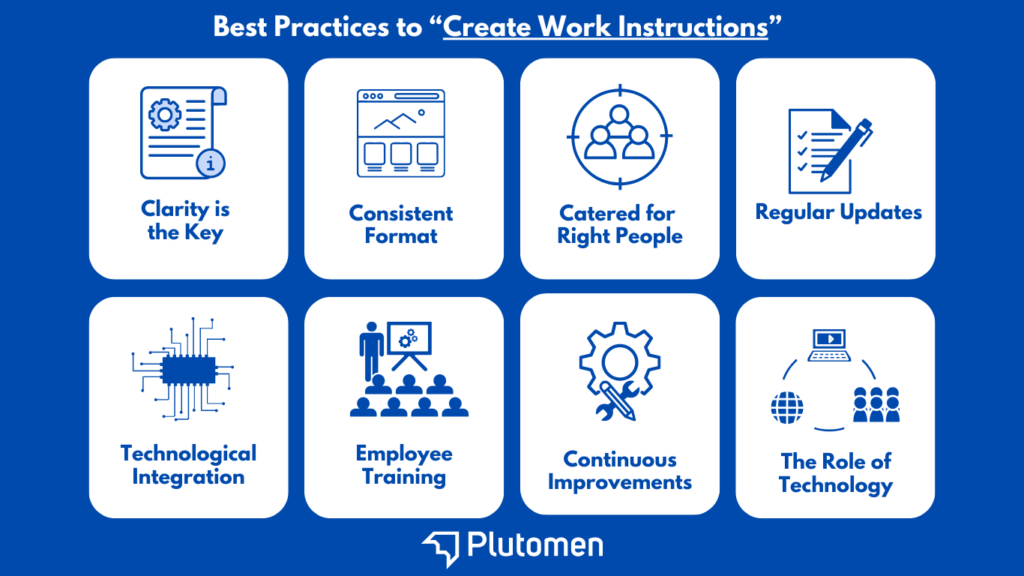
best practices for work instructions

Created by Plutomen to Illustrate Best Practices for Work Instructions!

Best Practices for Creating and Implementing Work Instructions

Practical work instructions are essential for streamlining operations and ensuring employee safety and productivity. Here are some best practices to consider:

  • Clarity is Key: Work instructions should be crystal clear. Use simple language and avoid jargon. Incorporate visuals when necessary to enhance understanding.
  • Consistency Matters: Maintain a consistent format and style across all work instructions to reduce confusion and improve readability.
  • Tailor to the Audience: Consider your audience’s knowledge level and experience when writing instructions. Provide additional guidance for beginners and experts alike.
  • Regular Updates: Work instructions should evolve with your processes. Regularly review and update them to reflect changes and improvements.
  • Embrace Technology: Modernize work instructions by leveraging technology. Consider digital platforms that offer real-time updates, multimedia integration, and mobile accessibility.
  • Employee Training: Train employees on how to use work instructions effectively. Ensure they understand the importance of following instructions precisely.
  • Continuous Improvement: Encourage employee feedback and incorporate their suggestions to refine work instructions.
  • Role of Technology: Technology is vital in modernizing work instructions. Digital platforms and apps allow for easy access and comprehension. They also facilitate real-time updates, ensuring that instructions remain current and relevant.

Following these practices and choosing the work instruction software that aligns with your objective can alleviate traditional challenges. It can streamline technical and non-technical task instructions efficiently and easily. Organizations can use this technology to create and implement work instructions that enhance operational efficiency, safety, and productivity.

Closing 

Stay curious and open to change; your path to operational excellence is paved with continuous learning and adaptation. Let’s build a future where work instructions are not just followed but inspire excellence at every step.

  • Unlock Operational Excellence: Dive into the world of work instructions secret sauce for efficiency, safety, and quality.
  • Diverse Tools for Diverse Needs: From Lean to Engineering, each instruction type is a puzzle piece in your operational masterpiece.
  • Craft & Implement: It’s not just about knowing; it’s doing. Tailor your instructions with clarity and tech smarts.
  • Keep it Rolling: Listen, tweak, and improve. It’s your playbook for a smoother, safer, and more productive tomorrow.

With Plutomen Workflow, frontline teams can access step-by-step work instructions, ensuring seamless task execution and standardized procedures across the workforce.

Discover how Plutomen can revolutionize your work instructions. Book a demo now!

Digitize your work instructions now with Plutomen!

Plutomen is digital work instruction software, helping OEMs digitize their traditional paper based instructions for thier frontline workers.

Request Demo NOW!
Augmented Reality Applications On Factory Floor

Download the eBook to learn about how augmented reality can be implemented on factory floor.

Download Ebook

FAQs

Work instructions aren't one-size-fits-all. For guidance on selecting software that fits your needs, refer to our work instruction software buyer’s guide. Complex tasks with new employees might require detailed video guides, allowing them to visualize each step. Conversely, routine tasks for experienced workers can be handled with simple checklists. Consider the complexity (think car assembly vs. light bulb change) and user experience (new vs. seasoned) to tailor instructions for optimal results. 

Imagine building a bookshelf without a manual! Work instructions are your recipe for success, ensuring tasks are completed consistently, accurately, and, most importantly, safely. They eliminate guesswork, minimize errors, and ultimately lead to better quality. They bridge theory and practice, empowering individuals to perform jobs effectively.

Your Task Roadmap: This detailed document outlines the step-by-step sequence for a specific workflow. Imagine a delicious cake recipe that details everything - from mixing ingredients to baking time and frosting techniques. Process work instructions are precious for complex workflows involving multiple steps and potentially different personnel. They ensure smooth and successful execution every single time.

Work instructions are a team effort! Experts craft the initial draft, while supervisors and quality control ensure accuracy, clarity, and safety. But the responsibility doesn't end there. Everyone plays a part! Employees should follow the instructions closely and report any issues to keep them up-to-date. This collaboration builds robust instructions, providing consistent quality and a safe work environment.

e key to adequate work instructions is clarity. They should be easy to understand and follow for anyone with the required skill level. Here are some tips: Keep it concise: Focus on essential information and avoid unnecessary jargon. Visualize your instructions: Diagrams, flowcharts, and photos can enhance user understanding. Test your instructions: Get feedback from potential users to identify confusing sections or missing information. Review and update regularly: Processes and technologies evolve, so ensure your instructions stay current and reflect any changes. By following these tips and prioritizing clarity, you can create work instructions that empower your team and contribute to overall success.
Keyur B

Keyur B

CEO, Founder of Plutomen

With more than 12+ years of experience in the world of enterprises, technology, and metaverse, Keyur Bhalavat is leading Plutomen to gain meaningful partnerships & to have a strong clientele network. He is one of the board members of GESIA (Gujarat IT Association Ahmedabad).

Recent Blog

Check out our latest blogs and news on all-things in Work Instructions.

Checklist vs. Work Instruction: Understanding the Differences

In today’s industrial landscape, efficiency and quality are crucial aspects. Whether you are a service- or product-based company, your audience will stay as long as you deliver them services well and fast. As industrial processes like machine handling, repair, moving, and whatnot can be challenging, a well-defined SOP is imperative to make them simple. Further, […]

September 18, 2023

What are Manufacturing Work Instructions?

Manufacturing is undergoing a major transformation—becoming faster, digital, and safer at an unprecedented rate. Of course, making this transition is not easy, but with assistance and training, it is achievable. Transferring knowledge to your workforce is essential. As jobs in the manufacturing industry become more digitized and the global supply chain becomes more complicated, it […]

January 10, 2025

Visual Work Instructions: What Are They And How To Create Them

Given the choice, which method would you rather prefer to learn a new skill or a task? Reading through a piece of text or visual work instructions? It’s a decision we’ve all contemplated and picked the obvious choice. So, when we understand visual instructions offer a much better learning mode for even a simple learning […]

April 16, 2024
Plutomen Logo
Privacy Overview

This website uses cookies so that we can provide you with the best user experience possible. Cookie information is stored in your browser and performs functions such as recognising you when you return to our website and helping our team to understand which sections of the website you find most interesting and useful.