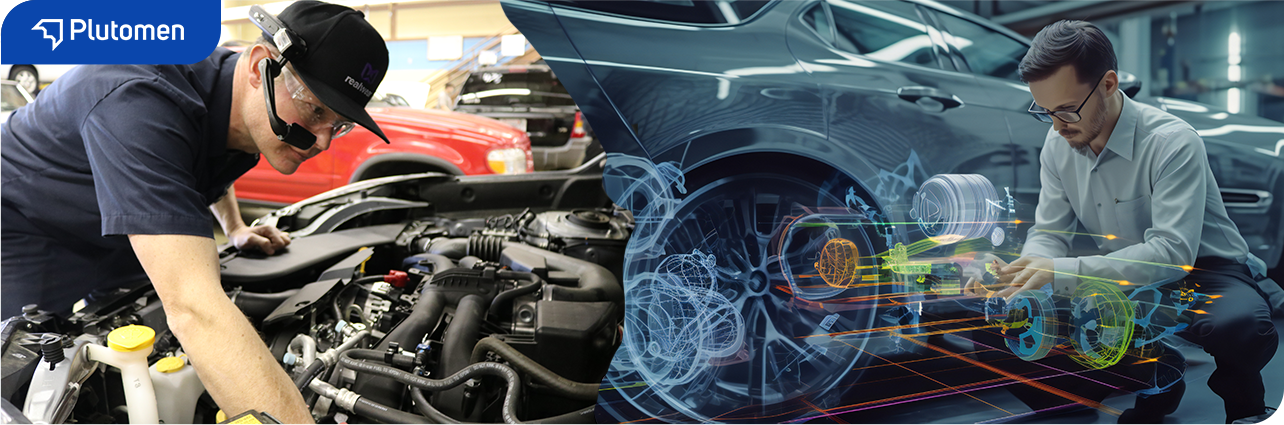
Top automotive manufacturers are already harnessing the power of Augmented Reality (AR) to transform their production processes, and you might be wondering why this technology is making such a huge impact.
“With the AR market in automotive growing at an impressive 18.1% CAGR, it’s clear that AR is not just a passing trend but a transformative force in the industry”.
Augmented reality has countless applications in manufacturing, testing, prototyping, etc., making it indispensable. The technology provides real-time, immersive insights that streamline processes, enhance efficiency, and improve the overall production quality.
In fact, in today’s competitive market, faster AR adoption is essential for your competitors. The sooner you adopt it, the shorter the ladder to the top.
So, how useful is augmented reality in automotive industry, and what are its benefits? We will unravel everything in this comprehensive guide!
AR in Automotive Manufacturing
Automotive industry companies constantly seek the latest technologies to improve their manufacturing process. Augmented reality in manufacturing is not a new concept – prominent companies including BMW, Porsche, Tesla, and many more have been using augmented reality.
Listed below are 8 use-cases and applications of AR in automotive industry:
What Are the Types of AR Used in the Automotive Industry?
Here are the key types of AR used in the automotive sector:
1. Design and Prototyping with AR
AR transforms vehicle design by enabling real-time virtual modeling and adjustments. This accelerates the design process, saving both time and money. With AR, designers can build virtual car prototypes, significantly reducing costs and enhancing safety. It goes beyond traditional CAD models on screens by providing immersive, detailed projections. Designers can walk around these virtual models and inspect every detail.
With AR, designers can quickly make changes to digital overlays of vehicles. Adjustments, like altering a headlight’s angle or a windshield’s curvature, are made with simple gestures. This flexibility reduces material waste and accelerates the prototyping process.
In 2019, Ford led the way by partnering with Gravity Sketch, a 3D virtual reality tool, to create more human-centric vehicle designs. The luxury car brand, Mercedes Benz, leverages the power of AR to create 3D models and visualize different assembly parts of the vehicle. Further, it also uses AR to offer remote support to technicians.
2. Assembly Line Efficiency
The assembly line of an automotive brand includes several portions. By portions, we mean that there are several stations where the engineer fits different parts of the vehicles. Now, AR cannot automatically fit the machine parts. However, the way these parts need to be fitted is supercritical. So, how can AR help here?
With the use of highly detailed and augmented reality car repair instructions, assembly line technicians and engineers can assemble vehicle parts in the correct order and the correct way. They can even add clear visuals to every step, this makes the worker’s task easy. Work instructions can be accessible from smart devices like phones, tablets, or smart glasses.
One of the finest examples of assembly line efficiency with AR is Volvo. The car brand is widely popular for its driver safety features. Other than that, Volvo is also popular for its efficient assembly line process. Volvo empowers its assembly line workers with AR glasses. The frontline workers receive instructions and necessary technical information about the vehicle on the glasses, which eliminates distraction and speeds up the assembly process.
3. Quality Control and Inspection
In the scope of automotive manufacturing, augmented reality is effective in enhancing quality control procedures.
Technicians leverage AR for visual inspections by employing digital overlays to check and emphasize potential defects or irregularities in the produced parts in real time. Augmented reality in automotive industry helps detect imperfections not visible to the naked eye.
This early identification of quality issues in the production process allows for prompt corrective measures, preventing the dispatch of altered components. The integration of AR in quality control not only enhances the overall product quality but also mitigates the risks associated with recalls or warranty claims.
Volvo is the same example here, too. Volvo uses AR tools to train its employees in quality assurance. As there are 40 checks that include 200 possible quality assurance variants, the brand must employ experienced personnel. Hence, it uses AR to provide immersive employee training to reduce training time and accelerate operations.
Another example of the same is Magna, a Canada-based parts manufacturer for automotive brands. The brand uses AR to offer enhanced visual inspection for production quality. The technicians can work through a user-operated tablet and a computer-aided design overlay to recognize part defects.
The tablet also guides and train the operators through a step-by-step sequence to verify the quality of the parts.
4. Maintenance and Repairs
AR is revolutionizing maintenance and repair procedures in automotive manufacturing. Through integrating AR overlays and digital assistance, technicians gain real-time access to comprehensive information about equipment and machinery, including manuals, schematics, and troubleshooting guides.
This facilitates precise diagnostics, boosts the repair process, and eliminates unplanned downtime.
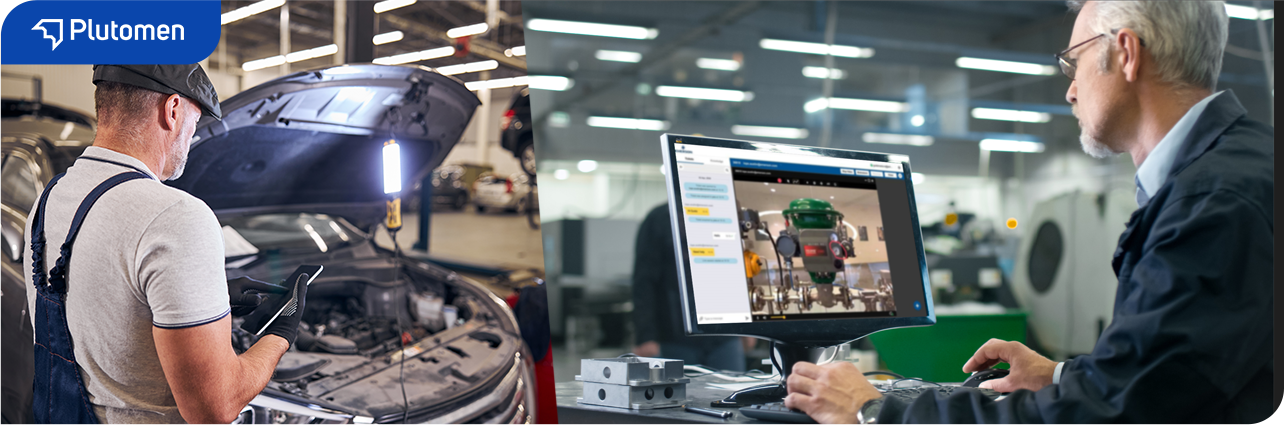
Moreover, AR opens avenues for remote assistance, enabling experts to provide immediate guidance to field technicians via AR-enabled devices. This not only eliminates the necessity for physical travel but also accelerates the resolution of issues.
With AR, manufacturers optimize equipment uptime, mitigate disruptions, and enhance overall operational efficiency.
A spot-on example of this is Porsche! The car brand utilizes augmented reality technology for technicians to get in touch with an expert via videoconferencing. Further, the expert sees what the technician does and provides him with remote assistance and guidance regarding fixing the issue.
Hyundai is another example of an automotive manufacturing company, which offers AR-based manuals to their customers.
5. Employee Training
Frontline workers’ training is an essential part of automotive manufacturing companies and augmented reality is making this process better. To stay updated with the latest information, technicians require regular instructions, and AR can be useful in this scenario.
Augmented reality facilitates interactive and immersive training experiences for new workers. Technicians can visualize complex machinery, processes, and safety protocols through AR, accelerating the learning curve and improving retention.
6. Safety
As the automotive industry advances towards the car of the future, numerous tech companies, including BMW, are integrating collision avoidance systems (CAS) into vehicles’ HUDs to boost driving safety. AR can enhance existing safety systems, such as side blind zone alert (SBZA), lane drift warning (LDW), and lane change warning (LCW), by providing visual augmentations. AR can help drivers with cognitive or visual impairments navigate under hazardous conditions, like nighttime driving. However, these technologies have limitations. They might distract drivers by splitting their attention between AR alerts and actual road conditions, which studies suggest can’t be processed at the same time. There’s a risk of drivers becoming too reliant on the AR system and missing essential cues. This overreliance is especially common among younger drivers.
7. In-car Systems
AR head-up displays (HUDs) can significantly enhance driving by providing navigation and dashboard functions. When designed effectively, they improve the driving experience; however, poor design can compromise safety. Research indicates that HUD placement can distract drivers, and different user interface (UI) types affect usability and glance behavior. HUDs also increase trust in automated vehicles, with users showing preferences for various route display options. Passenger-targeted AR systems, like Berger et al.’s interactive car door, improve user experience by offering entertainment and external information.
8. AR Car Repair Assistance
Popular brands are using augmented reality for remote car and vehicle assistance in automotive repair service centers. With AR systems, technicians wear smart glasses while they work on vehicles.
As they focus on a specific part, the glasses show a digital overlay. This overlay gives technical details, torque settings, service instructions, and more.
The use of augmented reality in car repair can serve various purposes, such as:
- Error diagnostics
- Repair process guidance
- Remote assistance
- Part identification
- Training and education
- Safety warnings
- Tool selection
- Visualizing complex assemblies
By offering instant access to information and guidance, AR reduces the time needed to diagnose and repair vehicle issues. Efficient repairs and diagnostics mean less time spent on each vehicle, leading to cost savings for repair services and customers.
Challenges of the Automotive Industry
The automotive industry faces numerous challenges that impact manufacturing, technology, and consumer preferences. They include:
Workforce Shortages and Skills Gap
The auto sector is moving from mechanical production towards a technological one. However, there is a shortage of trained labor. Auto producers must be involved in training programs and upscaling programs in order to fill this gap.
Complex Supply Chains
Automotive manufacturing is based on a huge global supply chain with numerous suppliers supplying various parts and raw materials. Coordination in production and timely supply could be difficult, especially in situations involving material shortages, logistical hold-ups, or geopolitical disputes. Disruption in any supply chain can result in increased costs, production delays, and customer dissatisfaction.
Quality Control and Safety
Modern vehicles incorporate advanced technology. The reliability and safety of such systems need to be guaranteed. In order to sustain consumer trust and company image, the manufacturers should establish efficient quality control mechanisms, comply with upcoming safety standards, and correct issues on time.
Benefits of Augmented Reality for Business
Backed by a treasure trove of applications, use of AR in automotive manufacturing offers endless benefits this include:
1. Saving Material Cost
Linking this to prototyping, one of the prime benefits of augmented reality in manufacturing is prototyping. As the production of a car part can be costly, augmented reality can help save a lot of material costs.
As there is no material required in making 3D projections, augmented reality is the perfect pick for prototyping.
2. Better User Experience
With the use of augmented reality tools, technicians and engineers of the automotive brand can verify the quality and accuracy of every machine part easily. This reduces the possibility of bad products in the market, thereby ensuring a better customer experience.
3. Minimum Downtime
As downtime can be costly for an automotive business, augmented reality can help reduce it. With the use of augmented reality remote assistance tools, on-site technicians can make faster repairs to the machines based on the instructions of an expert via video conferencing.
This helps in decreasing machine downtime and increasing productivity with AR.
4. Reduced Human Error
As 80% of defects in manufacturing are caused by human error, augmented reality can significantly reduce them.
Automotive brands can leverage AR-based digital instruction manuals and organize AR immersive training sessions for their staff. With hands-on experience in machines and processes, the possibility of human error will be minimal. Hence, the quality of produced products will be high.
With Augmented Reality for Business, the automotive industry is moving toward a more efficient, cost-effective, and high-quality future.
Conclusion
In conclusion, Augmented Reality is transforming the automotive industry, driving innovation across design, manufacturing, training, and user experience. As AR technology continues to evolve, its applications in the automotive sector will expand, offering unprecedented opportunities for efficiency, precision, and safety.
Top automotive OEMs see the value in using AR. It simplifies complex instructions, reduces part search time, and improves quality. This, in turn, increases customer satisfaction. Many AR solutions are easy to implement and provide quick ROI. They also offer long-term benefits and enhance reputational value. At Plutomen, we empower automotive businesses with AR-enabled solutions that streamline training, provide real-time guidance, and equip frontline workers with the knowledge they need to excel.
Discover AR Potential in Automotive
Maximize the benefits of AR in your automotive business with Plutomen.
Request a DemoFrequently Asked Questions

Keyur B
CEO, Founder of PlutomenWith more than 12+ years of experience in the world of enterprises, technology, and metaverse, Keyur Bhalavat is leading Plutomen to gain meaningful partnerships & to have a strong clientele network. He is one of the board members of GESIA (Gujarat IT Association Ahmedabad).