In the dynamic landscape of industry 4.0, service organizations are constantly seeking innovative ways to enhance productivity, efficiency, and safety. One such solution gaining momentum is Connected Worker.
An ecosystem that connects workers with each other in an industrial setup environment, thereby increasing their productivity, safety, and skills. These workers are connected by different set of technologies that help workers being productive and skilled
In this comprehensive guide, we’ll delve into the intricacies of Connected Worker Technology, explore its myriad benefits, delve into its diverse applications, and provide real-world examples to illustrate its transformative potential.
So without further ado, let’s get started.
Connected Worker Technology: What is It?
Connected worker or connective technologies exchange data actively. They encompass hardware and software, contextualizing worker actions in real-time. This integration optimizes workflows by facilitating seamless communication between devices and machines. In general, they can be defined as a suite of digital tools and devices designed to empower workers with real-time information, communication capabilities, and insights to perform their tasks more effectively. At its core, it leverages the technologies like Augmented Reality/ Virtual Reality, Internet of Things (IoT), AI, wearable devices, and data analytics to create a seamlessly interconnected work environment for industrial workers.
Thanks to its surging market and widespread adoption, the use of connected worker technologies is on the rise. Several businesses worldwide, like Mars Inc., Newport News Shipbuilding, Deloitte, DAQRI, and many others, have used connected worker technologies to empower their workforce to perform better.
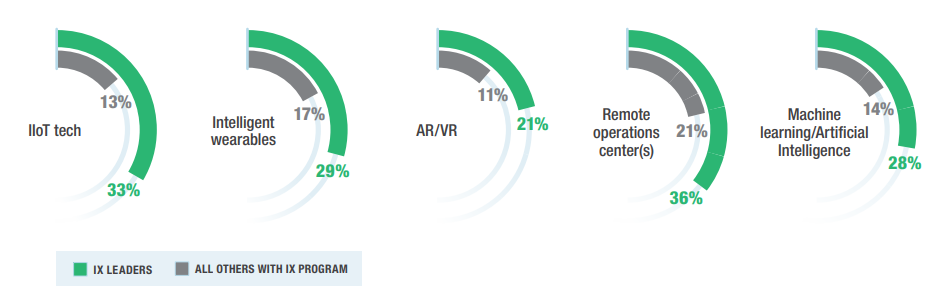
Here’s an image by LNSresearch that represents the adoption of 5 different Connected Worker Technologies worldwide:
Let’s discuss these connected worker technologies one by one:
Top 5 Connected Worker Technologies
1. IIoT tech
One crucial aspect of connected workers is worker-to-machine communication. IoT helps in making this possible. Several businesses use smart sensors in their manufacturing plants. Sensors like temperature, pressure, humidity, and heat sensors are fitted on machines to monitor their working conditions.
After detailed analysis, the data collected from the machines is shared with the workers on their handheld devices. If any abnormal data from the machine is received, a close investigation is done to find and fix the issue. This helps in maintaining machine health and enhancing overall production efficiency.
Bosch implemented IoT to keep its workers connected to their tools. It added sensors to the worker tools to make them easy to track. The process was called Track and Trace.
Other than Bosch, ABB, which is a power and robotics firm, uses IoT for the maintenance and repair of the robots. Smart sensors are connected to the robots that feed live data regarding the health of the robots.
2. Wearable Technology
The 2nd technology on the list is Connected Worker Wearable Technology. It includes several devices such as smart helmets, smart watches, smart bands, smart glasses, etc. The core purpose of these technologies is to help workers on the floor communicate with each other, handle machine operations safely, monitor machine parameters, and more.
For example, some industries use smart AR glasses that overlay digital work instructions on the glass. Workers can follow these immersive instructions with 3D animations to assemble or repair the machines better.
Boeing is an aviation firm that allows its technicians to lay down wires in the plane with the help of 3D wiring diagrams.
Also, DAQRI, a US-based company, developed an augmented-reality helmet to help construction workers. The helmet displays work instructions for the workers to follow. The helmet overlays computer-generated content on the real-world view of the worker, helping them understand the tasks related to the workspace context.
3. Augmented Reality/ Virtual Reality
Virtual Reality & Augmented reality are the most powerful and trending technologies of the 21st century. They have seen massive adoption in the entertainment sector. The market suggests its valuation to reach 77.5 billion by 2028. However, this is not at.
Other than entertainment, these technologies are also seen in other sectors, like manufacturing. For example, Augmented reality is used by businesses to design overlays of machine parts and vehicles for quality testing and training. Further, augmented reality plays a critical role in digital work instructions. Workers use digital work instructions with 3D AR visuals to handle, assemble, and repair industrial machines seamlessly.
Virtual reality, on the other hand, is used to create super Immersive training environments that allow the workers to obtain knowledge of everything in a machine inside out. An example of these technologies is Porsche. Porsche’s Tech Live Look is an AR solution that uses software and smart glasses to help technicians seek remote assistance from experts for maintenance and repair.
I would like to add another example here. One of my clients, an oil and gas provider firm, used AR-backed checklists and instructions for their inspection operations. The client was super happy with the solution as it helped them save 480,000 per year.
4. Remote Operations Centre
Remote Operations Centers (ROCs) are an integral aspect of Connected Worker Technology, facilitating seamless communication, monitoring, and decision-making across distributed work environments. Essentially, ROCs serve as centralized hubs from which remote operators can oversee and manage various operations, leveraging advanced technologies to ensure efficiency, safety, and productivity.
In a ROC setup, workers stationed at different locations, such as manufacturing plants, construction sites, or offshore facilities, are equipped with IoT-enabled devices and wearables that transmit real-time data to the central control center. This data encompasses vital metrics like equipment status, environmental conditions, and worker health and safety parameters.
5. AI and Computer Vision/ ML
The combination of Artificial Intelligence and computer vision is the most powerful tech in the connected worker environment. In fact, they are the two technologies that back several other industry applications.
For example, in the case of Augmented reality work instructions and guidance, computer vision is used to identify objects and provide annotations to the workers to handle the machines effectively. Other than that, computer vision is also useful in quality control. With powerful AI algorithms, any minor or major deviation or inconsistency can be detected and taken care of.
When it comes to artificial intelligence, it backs data analytics that is used to devise patterns and trends in the data collected from sensors across the manufacturing floor. Based on the analysis, predictive or preventive maintenance measures can be deployed. Moreover, artificial intelligence is also combined with augmented reality for remote assistance.
Benefits of Connected Worker Technology
Keeping in mind the cutting-edge benefits of connected worker technology, it is easy to say that its benefits would be beyond imagination. So, let’s dive into its benefits.
- Improved Productivity
The number one benefit of connected industrial worker is enhanced productivity. The productivity of a manufacturing plant depends on several factors, like machine health, worker safety, planned inventory, etc.
With the help of connected worker technologies, businesses can boost worker safety, enhance equipment utilization, get real-time data access, and much more.
The combination of augmented reality, IoT, AI, computer vision, and many other technologies helps businesses maintain a seamless connected worker environment and manage optimum productivity.
- Enhanced Safety
Every manufacturing and production business keeps worker safety as the paramount aspect. As per statistics, there are around 340 million occupational accidents across the world, which is a very big number. With the help of connected worker technology, these accidents can be reduced and even eliminated significantly. This aligns closely with the principles of connected worker safety, ensuring that technology-driven solutions prioritize the well-being of employees.
How?
With the use of augmented reality digital work instructions, on-floor production workers can properly handle every piece of machinery with step-by-step instructions along with 3D annotations.
Other than that, with the use of virtual reality simulation and smart glasses, workers can learn about the internal parts and workings of the machine without physically handling it. This leads to a safer working environment with hands-on skill enhancement.
- Real-time Data Access
The Internet of Things, or IoT, is the prime technology for this benefit. Real-time data access from all the machines on the production floor can be obtained via smart sensors and beacons fitted to and around them.
These sensors transmit data related to the machine’s temperature, pressure, humidity, and even harmful chemicals. This obtained data is analyzed by smart AI and machine learning algorithms.
Workers can comprehend the health of the machine and even its surroundings with the analyzed data. Further, necessary measures can be taken to restore machine health and eliminate downtime.
- Remote Assistance
Though connected worker technology focuses on improving the overall manufacturing or production workflow, it is possible that some minor issues may arise, such as machine breakdown.
To address these issues, connected worker technologies, such as augmented reality and mobile apps, can be useful.
With augmented reality remote assistance, on-floor technicians can consult experts via videoconferencing. These mobile apps have remarkable features, like annotations, screenshots, video freezing, video recording, and much more. With the help of annotations, experts can effectively guide technicians in making repairs while sitting in a remote location. This saves travel time and speeds up the repair or maintenance process.
Applications of Connected Worker Technology
Just like the benefits, I have discovered that the applications of connected worker technology are beyond limits. It can be used in several ways and across several industries.
- Manufacturing
Whether it is food, consumer products, automobiles, or something else, connected worker technology can be applied to every manufacturing business. For example, businesses can implement connected worker technologies like augmented reality in training their employees.
Volvo is a brand that uses AR to train its workforce, which can reduce production time. Further, smartwatches are used by BMW for quality control purposes. Smartwatches vibrate to successful completion of the task or to signal a discrepancy in the process.
- Construction
Construction is another area where the connected worker technology holds application. There are various areas of scope, such as project visualization, data access, structural analysis, and more.
Mobile apps and wearables can help construction workers stay connected with each other via high-speed internet. Smart sensors, along with audio and video input, can help in project and equipment monitoring. The use of AR and VR Technology can help assess structure quality and help in design planning.
- Oil & Gas
Unlike other industries, there are some unique utilities of connected worker technology in the oil and gas industry. For example, drones can inspect oil and gas facilities where humans cannot go, ensuring safety.
Wearable devices like smartwatches and risk bands can track workers’ vitals, indicating their health while working in a challenging environment. IoT sensors like gas detection sensors can alert the workers in case of any harmful gas, and relevant evacuation measures can be taken.
Real World Implementation Examples of Connected Worker Technologies
1. Boeing
Boeing, a leading aerospace manufacturer, utilizes Connected Worker Technology to enhance aircraft assembly processes. By equipping workers with smart glasses and augmented reality tools, Boeing has streamlined assembly tasks, reduced errors, and improved overall productivity on the factory floor.
2. General Electric (GE)
General Electric (GE) leverages Connected Worker solutions to optimize maintenance operations across its global facilities. By implementing IoT-enabled sensors and predictive analytics, GE can proactively identify equipment failures, schedule maintenance activities, and minimize unplanned downtime, resulting in significant cost savings.
Conclusion
Connected Worker Technology signifies a fundamental change in how businesses handle workforce management, safety, and productivity. By harnessing IoT, wearable devices, and data analytics, organizations can equip their employees with instant insights, streamline operations, and foster innovation across industries. Real-world cases from companies like Boeing and General Electric illustrate the substantial impact of Connected Worker Technology, delivering tangible advantages in safety, productivity, and efficiency. As businesses increasingly adopt digital transformation, investing in Connected Worker solutions will undoubtedly become a strategic necessity for maintaining competitiveness in today’s dynamic landscape.
At Plutomen, we offer a connected worker software that empower industrial workers with the knowledge, information, and skills they need to excel at their job. Request a demo today!
Frequently Asked Questions

Hiren Kanani
CTO, Cofounder of PlutomenWith 10+ years of experience, Hiren Kanani has helped Plutomen ensure smooth communication between the company and its clients for swift project delivery with fewer iterations. He is the CTO and founder of Plutomen.