According to the study of ‘Internet Live stats’, there are approximately 1.5 billion websites that are available on the internet in the world. This number however is not surprising by seeing the current trend of digitalization. Everybody wants his/her content or ideas or business or views to get tremendous reach that too in very much less time. And for this, website is a handy tool. But here the question is of better user engagement. What if you have created a good-looking website with exceptionally well design aspects but still users don’t feel connected to your site? Conventional website developing is becoming boring day by day. Newer innovations are promptly accepted to make the website much user oriented. These new innovations come on its way. One of such innovations is the use of augmented reality on website. It’s widely known as WebAR (Web augmented reality). First of all, let’s start with the basic idea of WebAR.
What Is WebAR (Web augmented reality)?
WebAR : the name itself is self explanatory. WebAR is a branch of augmented reality which makes us feel and experience the enhanced reality with the help of handy devices like mobiles, tablets, etc. What if we could experience augmented reality by just surfing? Well, this is possible with the help of WebAR.
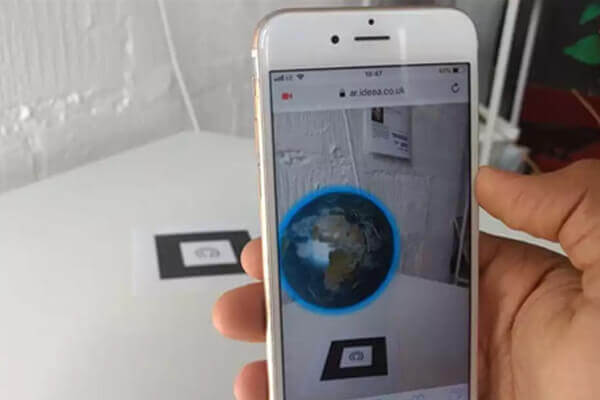
(Source: medium.com)
With the use of JavaScript 3D rendering libraries to show an additional 3D object projected of what the mobile device or any other device’s camera shows us in real time. The same idea can generate a simple looking but very impressive augmented reality experience that can be experienced by the one who is having a smart-phone or resembling device.
As our users and website visitors want something new and fresh on a daily basis on our sites, we must understand their needs. And WebAR may serve as the solution to these dynamic needs of the users. The most affected and benefited section of the market may be the field of advertisement. Printed Ads were having their own existence and importance in an older time, but in this digitally advanced era, marketing on social media and websites are becoming popular amongst the digital world. WebAR is nothing but just a further advancement of digital marketing beyond traditional social media advertising.
In particular cases, the print and social media advertising have lost their charm of advertising but WebAR could add a new interactive dimension to this conventional and may be somewhat outdated advertising methods. WebAR can do this by using AR for immersive personalized and interactive experiences. Because if we think about the question that which tool is handy and catchy for the user? Definitely the answer would be handy electronic devices and websites. It will help us to convert the users. A call-to-action during the WebAR experience can make sign-ups, make a booking or make a purchase very much easier as possible for users.
Why consider WebAR?
Attention is what every content creator is fighting for today and there is no better way to make user spend more time on your content than interactivity. It has become a powerful tool for content creators to engage users and leave a lasting impression. Augmented Reality (AR) experiences, particularly WebAR, have emerged as a game-changer in this regard. Studies suggest that by integrating interactivity into content, messaging can become up to 80 percent more memorable to users. This, combined with the ability to share AR content directly from one’s website, offers a tremendous opportunity to maximize the impact of content strategies without relying on third-party platforms.
Here are few more reasons to consider WebAR:
- Accessibility and Convenience: WebAR allows users to experience augmented reality content directly from their web browsers without requiring any dedicated mobile apps or installations. This ease of access makes it more convenient for users to interact with AR content without any barriers.
- No App Downloads: Unlike traditional AR experiences that often require users to download specific apps, WebAR eliminates the need for app installations. This can lead to a higher adoption rate, as users can instantly access the AR content through a simple URL or QR code.
- Cross-Platform Compatibility: WebAR is built using standard web technologies like HTML, CSS, and JavaScript. This enables it to work across various devices and operating systems, such as smartphones, tablets, and computers. It ensures a broader audience reach without the need for platform-specific development.
- Cost-Effectiveness: Developing and maintaining dedicated AR apps can be costly. WebAR can be a more cost-effective option, as it allows businesses and developers to create AR experiences using existing web development skills and tools.
- Integration with Web Content: WebAR can seamlessly integrate with existing web content and marketing campaigns. It can enhance user engagement on websites by providing interactive and visually appealing experiences.
Now that we understand the power of WebAR, let’s explore how WebAR works to deliver these engaging and interactive experiences.
How WebAR Works?
WebAR, or Web-based Augmented Reality, utilizes the existing mobile software and hardware to seamlessly overlay 3D virtual elements onto the real world. This technology relies on various hardware instruments, including orientation, gyroscope, RGB camera, accelerometer, and magnetometer, to create a compelling augmented reality experience.
- Six Degrees of Freedom (6DoF): WebAR employs six degrees of freedom to track the movement of a virtual object in a three-dimensional space. It involves monitoring the model’s three axes of orientation (yaw, pitch, and roll) and three axes of position (surge, heave, and sway), which correspond to the body movements of the user. This tracking allows the virtual object to move and interact naturally with the user’s physical environment, enhancing the sense of realism.
- Camera Stream: The Camera Stream feature is crucial in synchronizing the virtual and real worlds. As the user moves the mobile device’s camera, the digital object within the AR experience follows the corresponding movements around the predefined axes. This synchronization provides a seamless and immersive user experience. The RGB camera is also utilized to provide the necessary perspective and field of view, further enhancing the realism of the AR content.
- Scene Understanding: WebAR employs scene understanding to map the surfaces of the real-world environment and assess the surrounding lighting conditions. By doing so, the AR system can accurately place 3D virtual objects into the user’s physical environment, making them appear as if they naturally belong in the scene. This capability significantly enhances the believability and integration of the virtual content with the real world.
- Cloud-Based CMS (Content Management System): WebAR utilizes a cloud-based CMS to manage and deliver AR experiences to users. This system enables users to access AR content from anywhere and at any time, simply by scanning a QR code or accessing a specific URL. The cloud-based nature of the CMS ensures that updates and changes to the AR content can be implemented in real-time, providing users with the most up-to-date experiences.
Following is the tool that is used with web AR:
Augmented Reality JavaScript (AR.js)
AR.js is a very effective tool because it runs entirely in a web browser, so you don’t have to download an app. This also means that you do not have to buy a particular device, such as an iPhone, to enjoy web AR. It will work on iOS 11, Android, Windows Mobile, or any other platform. It runs very fast, even if your phone is not so new and AR js is entirely open source and available on GitHub. For those of you who like A-Frame, it works well with AR.js
Another tool that is used with web AR is QR codes. Basically, you scan the QR code with your phone, and you will be redirected to a web page which will take you to the AR content. As you can imagine, such QR code augmented reality has many uses to it.
Well, you must be imagining that since mobile phones are involved in most use cases, how WebAR is different than App-based AR. Lets take a look at difference between both of them.
| Feature | WebAR | App Based AR |
| Accessibility | Instant access via web browsers. | Requires app download and installation. |
| Cross-Platform | Works on various devices and OS. | Platform-specific, needs separate apps. |
| Content Sharing | Easily shared through URLs or QR codes. | Limited sharing, requires app presence. |
| Development Costs | Cost-effective, uses standard web tech. | More expensive, platform-specific devs. |
| Real-Time Updates | Instant updates on the web server. | App updates need user downloads. |
| Performance | Limited by browser capabilities. | Direct access to device hardware. |
| Offline Access | Typically requires an internet connection. | Can offer offline access to some content. |
Challenges of Using WebAR
WebAR presents challenges in maintaining a consistent experience across different web browsers, as each browser has its own rendering capabilities and compatibility with AR technologies. This can result in variations in performance and behavior, requiring thorough testing and optimization.
Another challenge is the performance limitations of web browsers. Unlike native AR apps that can fully utilize a device’s hardware, web browsers operate in a synchronous manner, leading to potential latency issues for certain AR applications. Complex AR experiences may struggle to deliver smooth performance, especially on older devices or slower internet connections.
Additionally, WebAR faces memory constraints and limited access to certain device capabilities. Web browsers can only access specific parts of a device’s functionality, limiting the implementation of advanced AR features that rely heavily on device-specific sensors and hardware.
Despite these challenges, WebAR’s accessibility and no-app-download requirement offer convenience and reach. However, integrating AR experiences into product development demands technical expertise to navigate these limitations effectively. By improving web technologies and AR APIs, the potential for WebAR to become a more powerful and widely adopted platform for immersive experiences increases.
Few WebAR examples
Augmented Reality in Browsers: Such as Argon4, AR browser, SDK, etc.
Augmented reality GPS: AR GPS Compass map 3D,AR GPS Drive/walk navigation, etc.
Lenskart : Lenskart is an online store for the spectacles. Earlier, they created the website and added an AR feature on it. With the help of this AR feature, the user is enabled to wear the desired frame of spectacles digitally to see how it looks on him/her. All this process was based on augmented reality. However, after some time of launching such webAR, lenskart shifted on making app for the same. But this AR feature had created a buzz in the market.

(Source: Google)
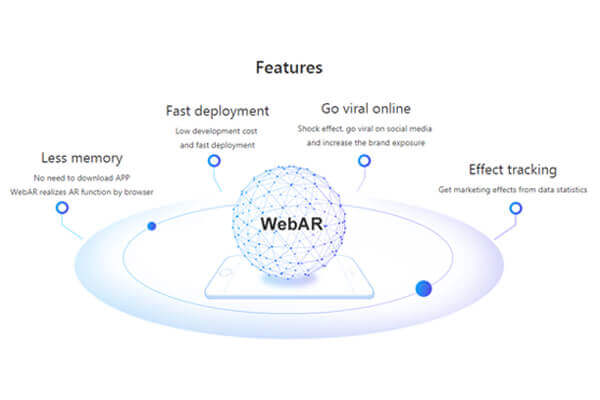
The essence of WebAR is shown in the figure below:
(Source: Google)
In this context there are other terms that we should learn about. And those could be simplified one by one as follows:
Related experiments
Web based AR is a segment of web development that uses regular smartphones to provide the user with an AR experience. A marker is used to orient the scene, and then current JavaScript 3D rendering libraries are used to depict a 3D object shown on top of whatever is in front of the cell phone camera. The result is a simple yet immersive experience that pretty much anybody can enjoy.
A firm called ‘nexus interactive arts’ has started experimenting on web based augmented reality. There are 4 experimental platforms are created by them. We will see them one by one.
WeathAR
WeathAR is a real time responding website that helps you to find out the weather conditions around you on real time bases. It will only require your location permissions and there you go.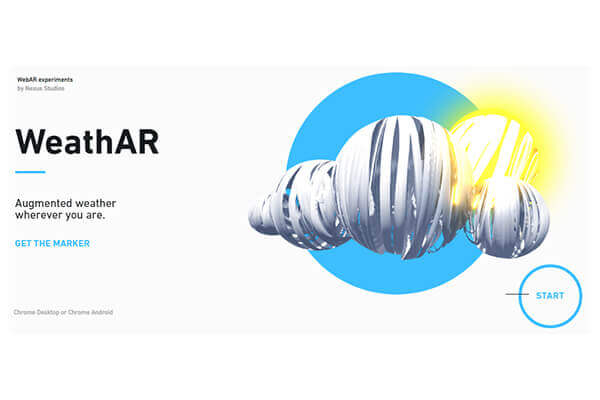
SolAR
SolAR is a visual aid which helps us in understanding our solar system. 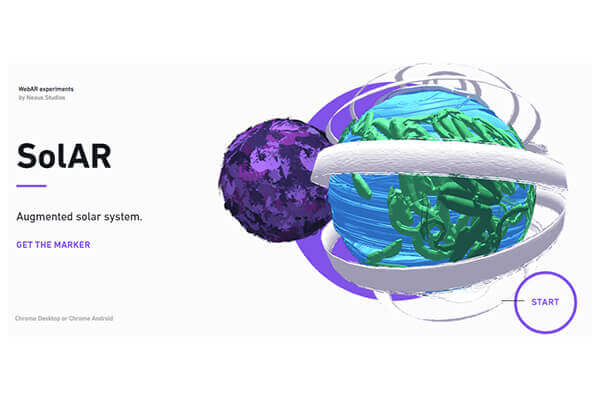
HoroAR
It is the platform on which showcases the current local time around the world. This project retrieves your location then renders the earth in relation to where you are at the current moment. Just move your phone around you to find local times in every location on earth. 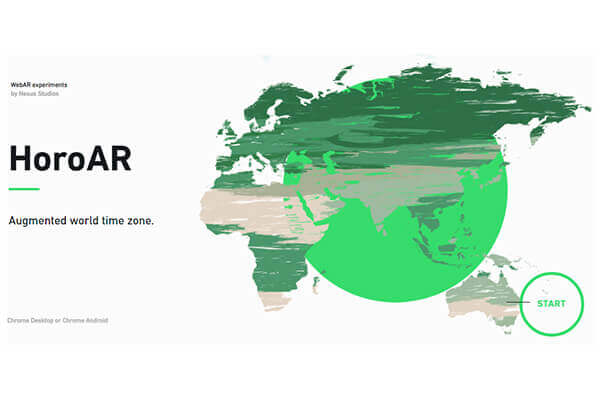
ARTE
ARTE is simply an interactive and augmented art gallery in the palm of your hand. This will be having two markers: one will be on a display of the sculpture and another to navigate between artworks. All assets are 3D scans, made public by the Louvre Museum.
After getting this much brief about the Web augmented reality, let’s discuss the advantages that we will have after successful implementation of Web augmented reality. The sound benefits of WebAR may be concluded as follows.
Benefits of WebAR Technology
- Conversion may be considered as the key benefit. All users who are interacting with the website will be on their mobile device in a browser. By calculating the drop off, point we can introduce a call-to-action during the experience just before the user leaves the website. Third party authentication services like Login with Facebook will work especially well for this use case, by allowing a conversion in as little as 3 taps.
- Dynamic content is another major benefit. By using services like geo-location and social media, we can create experiences targeting to the specific users age, interests or who they follow on social media. An example of this could be an advertisement for a clothes store. This website dynamically changes what clothes are shown in the AR experience based on the weather at the users’ location.
- With online advertising methods like PPC (pay-per-click) we have the opportunity to make highly targeted adverts, but more importantly, online advertising allows the advertiser to see what demographics are responding to the advert. By having users engaging with WebAR, we have a great potential to capture some valuable detailed data or information such as age, gender, geo-location, etc. on the users interacting with the advertisement using existing services like Google Analytics and others.
- WebAR helps a user to reduce the ROM usage of the mobile or desktop. By having availability of WebAR, you don’t need to install separate app for the same and that is why you would save much space of your device’s storage.
- WebAR enables us to keep track of users’ interests and demands on a daily basis, so that we will be in constant engagement with our user and hence we will be able to generate more user/customer base on the internet.
- It is also having the advantage of fast deployment time with lower costs. We can deploy our products in faster way using webAR and that too with the minimal investment. This will save money and time at the same time.
- With WebAR, one can develop such an interesting and connecting ideas which may go viral on social media as well. Here, by only using social media will not get you the benefits of WebAR but vice versa is possible.
- By the ideas like online product launch, one can save a large amount of resources and that too without compromising the reach and effectiveness as well. This will greatly benefit the manufacturing and services sector.
The Future for AR Web Design
Augmented reality is an emerging technology and as we all know that emerging technologies are having challenges for developers and designers. AR web design increasingly goes dynamic. Investment in optimizing AR-infused desktop experiences becomes tricky, complex and time consuming at the same time. Though there is a great potential for AR on the web—it could be used in many applications such as shopping, education, entertainment, etc.
Targeting the audience and their user base would be crucial for the developer before taking advantage of AR. They must keep in mind one thing that AR is much more dependent on customer experience than VR (which is expressively used for gaming). Ultimately, AR is revolutionizing the web design industry and the best that is yet to arrive.
Summary
We have just seen some different and exciting ways web AR can be implemented, but what is just as impressive is that it is a win-win for everybody. For developers, this technology offers faster deployment times and fewer costs. For consumers, one of the main benefits is the accessibility. Everybody loves augmented reality. And users anywhere, will be able to enjoy it regardless of the device they are having. Furthermore, it can be used for all kinds of purposes to immerse the user in the content. While this could be for both commercial and educational purposes, the most important thing is that it opens up a lot of opportunities.
Frequently Asked Questions

Hiren Kanani
CTO, Cofounder of PlutomenWith 10+ years of experience, Hiren Kanani has helped Plutomen ensure smooth communication between the company and its clients for swift project delivery with fewer iterations. He is the CTO and founder of Plutomen.