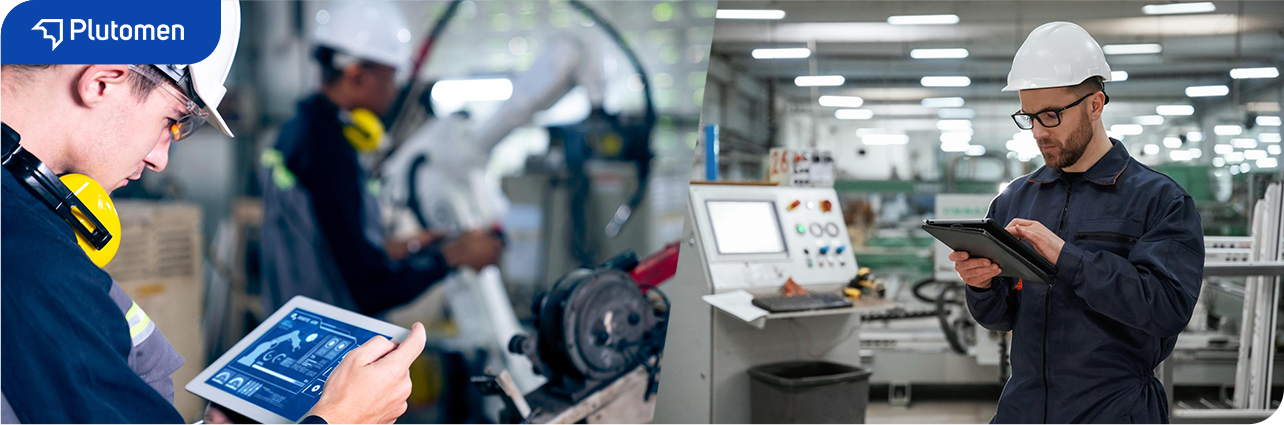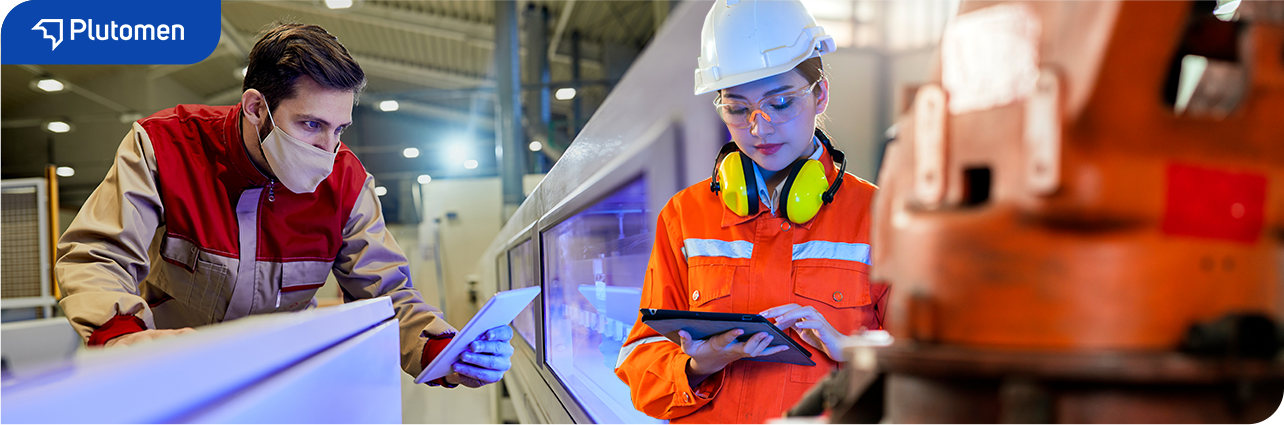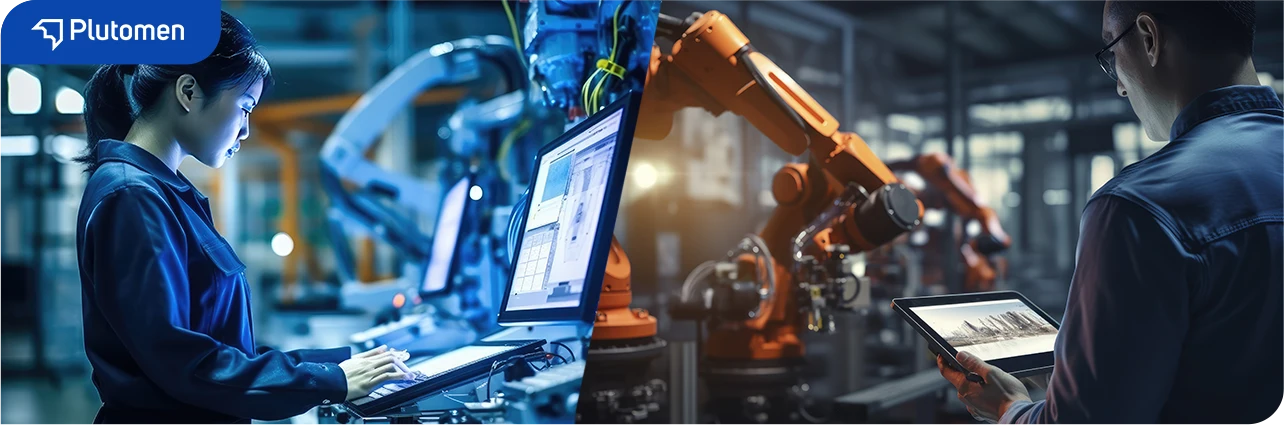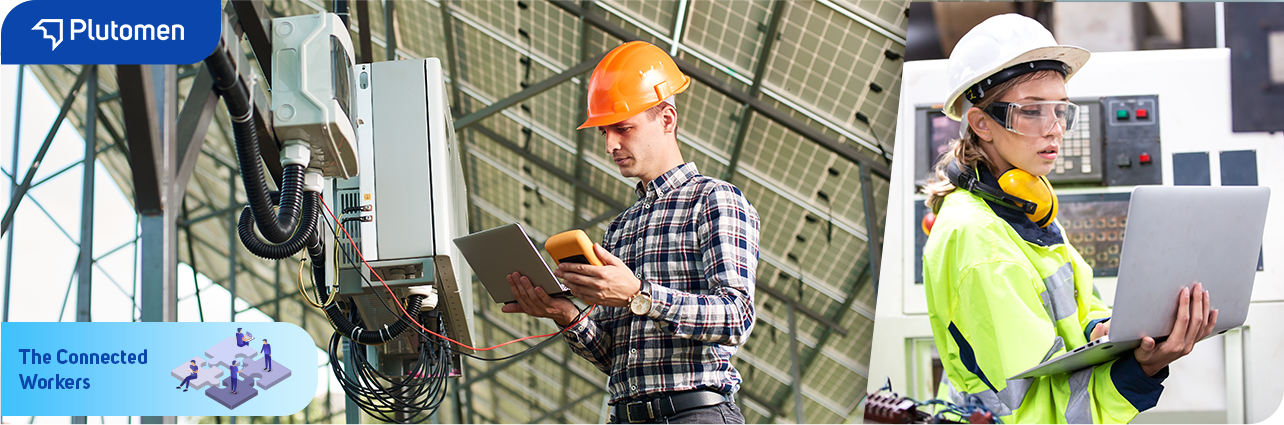
Forget clipboards and endless radio chatter. Connected worker solutions empower frontline teams with real-time data, streamlined workflows, and the ability to make informed decisions.
Take an example from telecom giant Nokia. Its global manufacturing facilities are transforming thanks to a connected worker program powered by Nokia’s technology. Factory workers seamlessly interact with colleagues, access data from connected equipment, and collaborate within complex systems.
This is just one example of how connected worker technology is revolutionizing industries. Across the board, companies are witnessing:
- Soaring Productivity: Streamlined workflow data access boosts worker efficiency.
- Enhanced Quality Control: Real-time data capture ensures consistent quality processes.
- Improved Safety: Protocols and alerts create a safer frontline environment.
If you want to eliminate inefficiencies in your frontline operation with a connected worker system, read this in-depth article. It combines everything you need to know to empower your field workers to become connected.
What is a Connected Worker?
A connected worker is a front-line worker who utilizes digital technologies or smart wearables to stay interconnected & collaborate efficiently with colleagues, access real-time information, & perform tasks efficiently. The entire concept of the connected worker involves the integration of digital solutions like smartphones, wearable devices, and cloud based software platforms. The Connected worker solution mainly focuses on connected worker safety and minimizing risk. This solution offers better remote connectivity, task optimization checklists, and training programs.
Stats Showing the Rise of Connected Workers
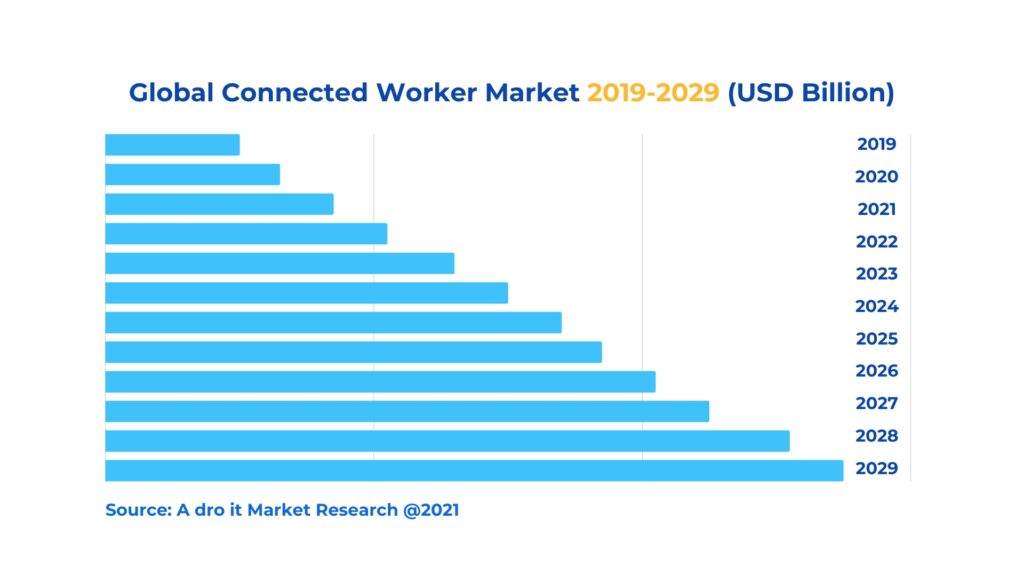 According to Adroit Market Research, the global connected market is expected to reach US$ 21.73 billion by 2029 at a CAGR of 23.2% during the prediction period. This is a very huge rise in the global market from US$ 3.19 billion in 2022.
No wonder it’s true that connected workers are transforming towards the digital world by adopting advanced gadgets to operate remotely. There was a positive impact on market growth after the global outbreak of the COVID-19 pandemic. The massive increase in connectivity and flexible work requirements has mostly led to the emergence of new technical solutions. These solutions enable more intense, seamless, and remote access to the real world.
Industries have started adopting connected worker solutions, which allow the workforce to work more effectively and accurately. Connected wearables also allow workers to solve errors by connecting remotely, increasing the demand for connected workers’ solutions.
Benefits of Connected Workers
There are rapid changes in the manufacturing industries. And in this digital era, it is necessary to adopt digital technologies for those workers who are thinking of succeeding in their field. This is a step towards a successful career. Connected worker solutions empower workers to make real-time decisions and improve the process. However, there are many benefits of connected workers
Improves Workers Safety
With end-to-end connected worker technology, workplace risks and accidents are prevented and reduced, improving worker safety. It also addresses unsafe conditions.
Provides Detailed Information
Many manufacturers offer data based on cycle times which mainly refers to the hours or days between placing an order and delivery. But what happens in the middle of the process? This is really a mystery! Nevertheless, with the help of a connected worker platform, you can get complete insights and detailed information into the frontline work.
Put Necessary Information at Your Fingertips
What’s more important than the manufacturing industry is to have the necessary information at the worker’s fingertips. Connected worker technologies provide all the essential information to the workers by linking them to central knowledge bases and support staff.
Prevent Making Unintentional Errors
We all make mistakes, for it is an inevitable part of being human. Not even technology can change human behavior. However, connected worker solutions can provide real-time assistance and prevent frontline workers from making unwanted errors.
Enhances Efficiency
It enhances the efficiency of connected workers and can even work collaboratively. As a result, this will increase productivity and save costs.
Connected Worker Technologies to Digitally Transform Operations
Emerging technologies have made connected workers possible. Now without wasting time, let’s explore some connected worker technologies to digitally transform operations:
Platforms
Platforms play a crucial role in connecting workers to their processes. Systems like IIoT platforms allows to connect with shop floor processes with the help of back-end systems. Hence, they serve as a crucial tool for connecting workers. With platforms, engineers can develop applications to address specific issues. A new connection is formed between machines, devices, and applications, hence controlling manufacturing processes.
Smart Sensors and IoT Devices
A device that collects particular information from a physical environment with wireless communication & programming is referred to as a smart sensor. And after that, it passes the data from connected networks to the gateway. Nowadays, industrial sensors can transfer data in real time, offering them a complete picture of industrial operations and workers. In a nutshell, these sensors play a significant role in existing IIoT networks.
Interfaces
Gone are the days when only traditional on-machine HMIs were used. Now in many industries, tablets and mobile devices are being used. Modern HMIs can operate in advanced industrial applications. Hence, these allow workers to share data and connect with the environment more effectively.
Wearables
The adoption of AR in industry 4.0 has increased the productivity of frontline workers. It renders contextual information to the workforce with the help of smart devices such as RealWear wearables. Now, sensors have become more adaptable and smaller, which can be fitted easily. This hands-free instruction not only boosts productivity but promotes safety too.
Mobile Devices
It’s becoming more and more common to access industrial applications through smartphones, much as we do with mobile applications. Whether you want to know the machine status or digital work instructions will be available on mobile devices whenever needed.
Augmented Reality & Virtual Reality
Augmented Reality (AR) and Virtual Reality (VR) are connected worker technologies that leverage digital simulations and overlays to enhance the work experience. AR supplements the real-world environment with digital information and visuals. Connected workers can use AR to access real-time data, instructions, and visual cues overlaid on their physical surroundings, aiding in tasks like maintenance, remote assistance, and training. VR creates immersive, computer-generated environments. In a connected worker context, VR allows employees to engage in virtual training sessions, simulations, and remote collaboration as if they were physically present in a different location, fostering more effective and efficient communication and learning.
[Ebook] Augmented Reality Applications On Factory Floor
Elevate Factory Efficiency with Augmented Reality! Discover Game-Changing Applications of AR on the Factory Floor!
Download EbookDifferent Types of Connected Workers
For a majority of people, connected workers maybe field technicians or manufacturing workers. However, there’s more to that.
Connecting workers not only empowers the whole business, but also your entire ecosystem of workers, machines, and stakeholders. Following are the different types of Connected workers:
Connected operators
Connected operators get support from the working systems that respond to their actions in real-time. This support can be in any form of digital work instructions, or it can be in a communication tool that allows the machine operator to send a notification when they face any issues. It provides you with automated error-proofing and computer vision systems that provide solutions to an operator’s actions effectively. Here you will get end numbers of options, and the option should be selected based on the needs of your operations.
Field Workers
Field workers have different needs as compared to other connected workers. Their work is really difficult and it is carried out in a challenging situation. AR in field service provide necessary support and information to connect field workers. They use mobile-accessible schematics or communication devices and collaboration platforms to get information. As a result, this can improve workflows and reduce dependencies.
Engineers
Today’s modern manufacturing systems are quite adaptable. Due to this, as per the requirements, engineers can make necessary changes in software, hardware, and even work cell arrangements. Connected engineers will also have real-time access to the most important KPIs for production, maintenance, and prevention.
Executives
Here information is collected by connected processes. This information is usually used to create efficiency, drive strategy creation, and, most importantly, can make more inbound decisions.
“No matter what position a connected person holds, it is the future of digital transformation.”
Choosing the right Connected Worker Solution for Frontline Operations!
Connected worker solutions are revolutionizing frontline operations, but with a plethora of options, picking the right one can feel overwhelming. Here’s your cheat sheet to navigate the selection process and unlock the true potential of a connected workforce:
- Deep Dive into Your Needs: Understanding your frontline heroes starts with understanding. Are they assembly line wizards needing digital instructions on smart glasses? Or perhaps field service ninjas require remote diagnostics on tablets? Identify their workflows and pain points to pinpoint the functionalities most crucial for success. Think real-time data capture, wearable device compatibility, or even augmented reality overlays for complex tasks.
- Align with Your Business Goals: Efficiency on Steroids? Quality control on autopilot? Knowing your desired outcomes is key. If speed is your game, prioritize solutions with robust task management and progress tracking. For quality control champions, focus on features that integrate seamlessly with inspection checklists and digital signatures.
- Tech Stack that suits existing Technology Stack: Don’t Get Stuck: Don’t let your IT infrastructure become a roadblock. Before diving in, assess your current tech stack. Can your existing systems play nice with the new solution? Avoid a system overhaul by prioritizing solutions with open APIs or pre-built integrations for your ERP, MES, or other mission-critical software. This ensures a smooth implementation and maximizes your investment.
- Future-Proof Your Investment: Your business is progressing upward, and your connected worker solution should follow suit. Opt for a scalable solution that adapts to your growth. Look for vendors offering modular systems where you can add functionalities as your needs evolve. Think of it as building your connected worker dream team – one powerful tool at a time.
- Security is King: Data security breaches can bring your operations to a screeching halt. Prioritize solutions with robust security measures in place. User authentication, data encryption, and granular access controls are non-negotiables.
You can make an informed decision by following these steps and considering the provided examples. The right connected worker solution will empower your workforce, streamline operations, and unlock significant efficiency gains.
Challenges That Can Be Solved with Connected Worker Platform
The main motto of the Connected Worker Platform is to assist businesses in going paperless or taking the next digital steps for frontline workers. It forms a crucial part of a comprehensive connected worker strategy, enabling businesses to streamline operations and enhance productivity.
By organizing and standardizing their information to be available during analysis, it also provides real-time information when needed. This strategic approach not only resolves immediate challenges but also lays the foundation for long-term improvements in workforce management.
Following are some challenges that can be solved with the Connected Worker Platform:
Remote Inspection
Nowadays, technology can transform the working environment and how workers perform their work. The connected workers are already adopting this remote inspection and remaining a step ahead in this digital era.
Work Protection & Safety
Connected worker solutions can alert potential hazards or even show emergency exit routes. With strong visual assistance, they are able to see the safety measures in their real environment. It can assist workers to act more quickly and efficiently during an emergency.
Identify Errors
There can be errors in the development process in any industry. However, a connected worker platform can help improve product development by analyzing the production process, identifying errors at an early stage, and taking the necessary steps for the same.
On-time Guidance & Maintenance
Many times, engineers need on sight guidance during maintenance and production. With a connected worker solution, one can provide support remotely and instantly. It makes it possible for technical staff to be in more than one place at the same time.
Key Features of Connected Worker Solution
- Real-Time communication is possible between technicians, workers, supervisors, and even with the safety control center.
- Step-by-step instructions are given to frontline workers to maintain workflow.
- Make phone calls and text in real-time.
- Avoid recurring visits of the entire team on-site; issues can be resolved even remotely.
- Capture images and recordings during the sessions.
5 Amazing Use Cases of Connected Workers
For many industries, connected worker solutions are essential. There has been an increase in the adoption of Connected worker solutions after the pandemic. It plays a vital role in many industries, including oil and gas, healthcare, automotive, and many more.
Let’s see how the Connected workers solution is useful in different industries:
Manufacturing
The connected workers in manufacturing industry maintain quality by conducting audits and enhancing the maintenance process. Moreover, it provides digital work instructions to empower your frontline workers. This makes your workflow seamless with digitized guides and reduces factory downtime.
Want to know a fantastic case study? Look no further than Ford! They utilize connected worker solutions in their automotive plants, ensuring worker safety, monitoring equipment (think IoT sensors!), and streamlining assembly processes. This, combined with AR for real-time information overlays and VR for design and testing production lines, has transformed their operations.
Healthcare
Medical centers globally are now turning towards the connected workers solution. It can be used in the remote inspection and augment resources to run operations smoothly. With remote assistance, connected workers can reduce cost and enhance productivity.
Heard about Johnson & Johnson? Yes definitely. There we go, from their baby products to medical equipment; Johnson & Johnson products are sure to be found in every chemist’s shop. What goes behind those high-quality, trustable products is utilizing connected worker solutions in their healthcare operations. For better decision-making & care delivery, their healthcare professionals are always connected through this smart approach. Not only that, in the supply chain field also, they ensure to be connected with digital tools that smoothly streamline the whole process.
Automotive
With the adoption of augmented reality and digital work instructions, connected workers can upskill the frontline workforce. It troubleshoots all repair issues by providing quick solutions in limited time, in turn increasing customer satisfaction.
Volkswagen, BMW, General Motors, and, of course, Ford. If there is one thing common in all these automotive companies, it is their back-end process and implementation of connected worker solutions. They leverage various connected worker solutions, which makes their background operations super strong and helps them maintain a competitive edge in the rapidly evolving automotive industry.
Construction
The Construction industry has a more serious risk compared to other industries. It is essential to have wearable solutions to eliminate mechanical failure that risks the safety of the frontline worker or stops construction activity.
If you still haven’t got the motivation to use connected worker solutions in your construction process for the safety of your workers, take inspiration from the world’s largest construction company, Skanska. Besides being popular for their constructed infrastructure, their thoughtful idea to digitally connect their front-line workers is also well known. They enable the power of technology like wearables, IoT, & real-time communication platforms to make bridges and bridge the gap between their workers. No doubt, they take care of everything from top-collaboration on-site to care of their workers.
Oil & Gas
In the Oil & Gas industries, frontline workers safety is increased by adopting wearables for hands free operation, reducing distractions too. Workers will get visual assistance for essential information, including repair & operation instruction, process steps, etc.
Shell, one of the notable Oil & Gas companies, has done all the above. Whether upstream, midstream or downstream, each stream is backed with connected worker platforms. By enhancing their workers’ safety and facilitating real-time communication between on-site field personnel and the support team, Shell has well-oiled their entire operations and well-prioritized their workers’ safety and assets.
Why Get Started Now?
Before it is too late, it is better to go with a connected worker platform. Let’s see the three reasons behind starting it now!
To Preserve Business Continuity
With remote assistance, workers can visually showcase complex features.
- One can connect with remote experts with wearables or on mobile devices. Experts will resolve your issues remotely.
- Guide your technicians through live video calls with marking or writing texts.
- Workers can record service sessions by capturing photos and videos for proof of work.
To Build Credibility by Meeting Commitments
At one point, it becomes necessary for some co-located workers to meet customers’ requirements while also maintaining social distancing.
- Workers from various industries can receive visual work instructions, step-by-step SOPs, and also capture photos or video for proof.
- Analyzing critical device data with a powerful web dashboard can minimize errors in performing tasks.
- Technicians can even manage their tasks with digital workflows.
To Thrive in the New Normal
For organizations, it is necessary to thrive in the new normal, as mobility restrictions would be essential for workers safety.
- Frontline workers can get remote visual assistance anywhere, anytime to simplify complex tasks.
- Technicians in the field can receive assistance from their devices such as smartphones or even a pair of AR smart glasses such as RealWear or HoloLens 2.
To Close the Skill Gap
The difficulty of filling open positions in the manufacturing industry has increased. This is due to the skill gap and misalignment between the workforce’s skills and the training required to carry out the work.
- The skill gap can be reduced with the adoption of connected worker solutions.
- It provides all the necessary information to the workers on time whenever required.
- It prevents from making human error.
Hence, with connected worker solutions, less time will be spent on training and in turn, getting better outcomes.
How Connected Worker Solutions are Changing the Future of Industrial Work
Today, frontline workers are becoming an important part of digitalization in the industry field. Smart AR-powered tools like remote visual assistance, digital work instructions, and AR training help the organization in increasing quality. Not only that, but it also gives insights into the development and suggests ideas for continuous growth.
Adopting Plutomen’s connected worker solutions can make your workforce thrive in the new norms. Plutomen facilitate organizations with improved first-time fix rates, decreased downtimes, and better impartation of knowledge.
If you too wish to empower your workforce and perform the task more efficiently with a connected worker solution, then Book a Free Demo now!
Frequently Asked Questions

Hiren Kanani
CTO, Cofounder of PlutomenWith 10+ years of experience, Hiren Kanani has helped Plutomen ensure smooth communication between the company and its clients for swift project delivery with fewer iterations. He is the CTO and founder of Plutomen.