COPQ represents all the hidden costs that occur when products or processes fail to meet quality standards. These costs affect profitability, production efficiency, and customer satisfaction, and can be reduced significantly with the right digital and connected-worker tools.
Enterprises focus on providing the best quality products at the lowest prices possible to their customers. The aim is to remain profitable while creating a loyal customer base. On the journey to being profitable, it is imperative to understand the actual cost of poor quality (COPQ).
What is the Cost of Poor Quality?
Poor quality costs the organization money and time. It affects not only the company’s reputation but also its bottom line. Poor quality leads to lower customer satisfaction, higher costs for rework, and lower revenues. Due to this, more time is spent on fixing issues with the product or service instead of creating new ones. Poor quality can result from a lack of focus, understanding, or even resources.
Why understanding the cost of poor quality in manufacturing is important?
- Cost reduction: Poor quality in manufacturing increases expenses due to rework, scrap, warranty claims, and customer returns. Understanding these costs helps identify areas for improvement and reduce defects in manufacturing, resulting in cost savings.
- Competitive advantage: High-quality products enhance a company’s reputation and customer trust. Recognizing the cost of poor quality in project management motivates manufacturers to invest in quality improvement, leading to increased customer satisfaction and loyalty.
- Efficiency improvement: Poor quality disrupts production flow and requires extra resources for rework, causing inefficiencies. Knowing the COPQ in quality in manufacturing enables identification of bottlenecks, streamlining processes, and minimizing defects, improving overall operational efficiency.
- Continuous improvement: Tracking the cost of poor quality measures the effectiveness of quality improvement efforts. By analyzing this metric over time, manufacturers can make data-driven decisions, drive continuous improvement, and enhance their products and processes.
- Customer satisfaction and brand reputation: Poor-quality products lead to dissatisfied customers and damage a company’s brand. Understanding the cost of poor quality highlights the importance of meeting customer expectations, investing in quality improvement, and building a strong brand reputation.
While understanding the cost of poor quality in manufacturing is important, there are also several disadvantages associated with it.
What Are the Disadvantages (or Consequences) of COPQ?
Here are six major consequences of unchecked poor quality:
- Financial Loss: Poor quality products can lead to significant financial losses as a substantial portion of revenue may need to be allocated for inspecting, investigating, and repairing damaged items.
- Schedule Delay: Lack of quality assurance in the manufacturing process can cause delays, which can have a cascading effect on the supply chain and disrupt the scheduled delivery of goods.
- Utilization of Human Resources: Inadequate quality assurance requires increased checks and controls, placing additional strain on quality managers and the management system. This can result in a waste of human resources and challenges in capacity planning.
- Increased Expenditure: Identifying and addressing quality issues often requires additional investment to reproduce or fix defective products, resulting in higher expenses for the company.
- Damage to Company Reputation: Poor-quality products that compromise customer health and safety can significantly damage a company’s reputation. A negative brand perception can lead to a loss of customer trust and loyalty.
- Customer Loss to Competitors: While dealing with quality-related costs and rebuilding brand reputation, competitors may seize the opportunity to attract and acquire customers who have lost confidence in the affected company.
Most enterprises have quality-related costs as high as 15-20% of their sales revenue. The costs may go as high as 40% of their total operations for some of them.Â
In short: what you save by skimping on quality, you may lose much more in consequences.
What Does the Cost of Poor Quality Include?
COPQ can be broken down into clear categories:

Cost Of Poor Quality Includes:Â
- Prevention costs – Investments made to avoid defects (e.g., quality planning, training, system design)Â
- Appraisal costs – Costs of evaluating quality (e.g., inspections, audits, supplier ratings)Â
- Internal failure costs – Costs when defects are caught before shipment (scrap, rework, waste). Â
- External failure costs – Costs when defects reach the customer (warranty claims, returns, repairs, lost sales).Â
In many quality-cost models:Â
Cost of Quality (CoQ) = Cost of Good Quality (conformance) + Cost of Poor Quality (non-conformance)Â Â
Knowing each component helps prioritize where to invest for maximum impact.Â
How To Calculate Poor Quality Costs In Manufacturing?Â
The cost of quality is calculated based on two essential components: The cost of poor quality and the cost of good quality. The cost of good quality in the manufacturing business is a set of practices designed to ensure that the quality of products and services is high. A poor-quality problem triggers enterprises to invest in systems that ensure high quality. Â
Calculating COPQ accurately can be challenging — many companies underestimate hidden costs.Â
Here’s a practical approach:Â
Step-by-step:Â
- Identify and collect data for each failure type: scrap, rework, returns, warranty claims, lost production time, overtime, etc.Â
- Convert each failure event into monetary cost (labour, materials, overhead, lost opportunity).Â
- Sum internal failures + external failures (plus prevention & appraisal if you want full CoQ). Â
- Optionally express as a percentage of sales or total operations to benchmark (e.g., 15-20% of sales).Â
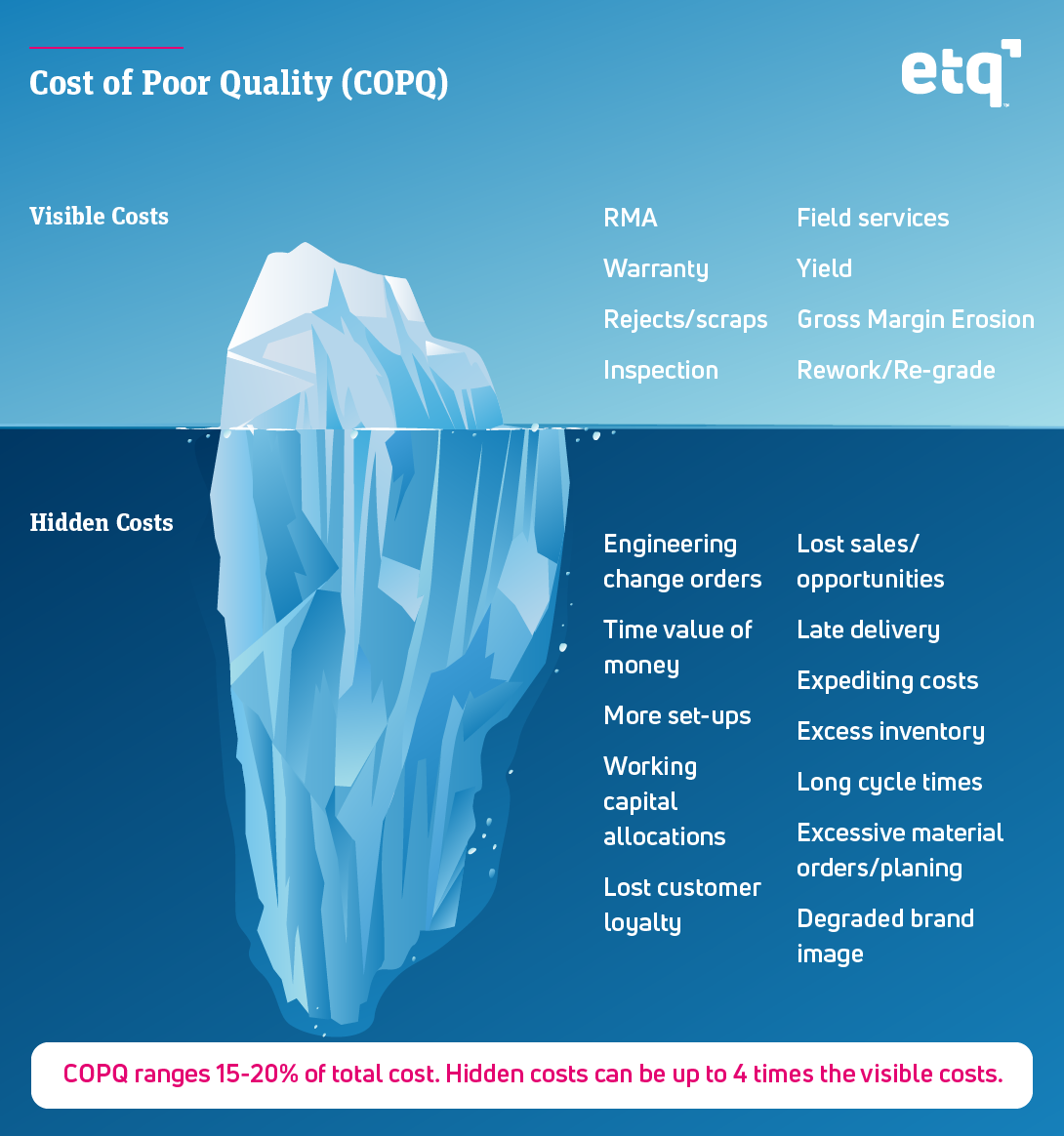
Image Credit: etqÂ
There are many components of the cost related to low quality. Here, we’ve listed some easily noticeable cost areas:Â
- Scraps and reworkÂ
- Resource used for rework and scrapÂ
- Wasted time on manufacturing low-quality productsÂ
- Energy wasted on unusable materialsÂ
- Materials used in scrapÂ
- Warranty claimsÂ
- Customer finesÂ
- New product and delivery costs for replacementsÂ
These are just a portion of the actual poor-quality cost. There are many other losses like:Â
- Planning delaysÂ
- Replanning for scrap and reworkÂ
- Overtime by employees for meeting deadlinesÂ
- Time lost on identifying root causesÂ
- Time spent on correcting and preventing plans to prevent low-quality problems from happening againÂ
- Time, money, and energy are spent on marketing to regain brand image and restore trust in the brandÂ
These are the costs manufacturing industries pay for low quality. The cost of low quality cannot be calculated by operations or finance staff alone. They must work together to calculate it. Â
Cost of poor quality examples in manufacturing
To illustrate, consider a smartphone manufacturer producing 10,000 units monthly. If 5% are defective and require rework, with a unit cost of $200, the cost of poor quality in manufacturing amounts to:
5% of 10,000 = 500 units
500 × $200 = $100,000 (Total Loss)
The cost of poor quality in manufacturing doesn’t only include the defective items, but it also includes the cost of rework, warranty claims, customer returns, and in some cases lost sales.
What Is An Advanced Manufacturing Approach To Minimize Quality Issues?Â
Once you calculate the cost of poor quality, it is necessary to take actions that minimize quality issues and provide a high-quality manufacturing environment. Advanced manufacturing approaches can help you spot patterns in systems and can help you avoid problems.Â
Improved Process Communication & Visibility
In linked production setups, even minor upstream discrepancies might result in major downstream failure.
Improved communication, digitization of workflows, and real-time insight into job instructions and process status all help to decrease variability and quality risk.
Augmented Reality (AR)
AR overlays step-by-step instructions directly on machines, components, or workstations, ensuring workers execute tasks correctly the first time.
This leads to:
- Reduction in human error
- Faster onboarding and training
- Higher first-time-right execution
- Standardized work across shifts and lines
- Reduced reliance on tribal knowledge
IoT / Data Analytics / AI-Driven Predictive Quality
Sensors, machine data, and predictive analytics now enable manufacturers to:
- Detect defect patterns early
- Predict machine or process failures before they occur
- Trigger alerts and preventive maintenance
- Identify and eliminate recurring sources of waste
- Improve statistical process control (SPC) in real time
Digital Workflows & Automated Quality Checks
In order to have consistency and reduce human errors, it is essential to digitize SOPs, checklists, and inspections. Automated quality checks, such as vision systems, barcode scans, or digital validation, prevent faults from moving downstream
Remote Collaboration & Expert Assistance
AR-powered remote visual assistance helps frontline workers solve issues instantly instead of waiting for specialists to travel to the site. This reduces downtime, prevents repeated errors, and accelerates issue resolution, resulting in lowering COPQ.
Knowledge Capture & Skill Gap Reduction
Recording best practices, capturing expert knowledge, and making it available digitally ensures that all workers operate with expert accuracy. This reduces fluctuations in production caused by skill gaps or labour turnover.
How AR Helps Lower the Cost of Poor QualityÂ
To lower the cost of poor quality, everyone on the production line must have enough information on what’s been happening in the previous step and shifts. In manufacturing sectors, AR is used to help workers get details of the products in the production line. They can check the history associated with the product, like updates or maintenance as well.
AR is used to train frontline workers to use equipment in the production process by creating real-life virtual scenarios. This can be done through optical devices, such as a head-mounted display, or other means, such as a printed page or computer screen.Â
AR can be used to help workers with work instructions on the shop floor before they begin their shifts. Some factories use augmented reality smart glasses to provide instructions to workers on how to assemble parts and machines. This way, they can avoid errors that would have been made if they were assembling without the help of AR glasses. It will help them lower the chances of defective products, which ultimately reduces the cost of poor quality.
AR helps designers to create high-quality products by giving them all the information they need in one place. They can see how their product would look in different settings with different people using it. AR can help designers see how the product will look in real life and make changes accordingly. They can collaborate with experts when assistance or suggestions are needed. AR also helps with a rework that needs to be done to ensure product quality.Â
Conclusion: Reducing the Cost of Poor Quality with PlutomenÂ
With the increasing demand, the manufacturing industry is growing at a rapid pace. With all the technology in place, the manufacturing industry can leverage it to lower the cost of poor quality. This is where Plutomen creates measurable impact.
How Plutomen Helps Reduce COPQ
- Standardizes Every Process Digitally
Plutomen helps in replacing paper-based work instructions with interactive digital instructions to guarantee every activity is completed consistently, decreasing errors caused by variation.
- Delivers AR-Guided, Error-Proof Work Execution
Frontline workforce receives AR overlays, step-by-step instructions, and visual assistance, reducing errors and enhancing first-time quality.
- Enables Instant Expert Support to Avoid Escalation
With Plutomen Connect, experts can guide workers remotely through live video, AR annotations, and insights, helping resolve issues early and prevent scrap or process failures.
- Strengthens Traceability & Root-Cause Analysis
Capture photos, videos, and job data creates end-to-end traceability, enabling faster diagnosis of quality issues and stronger compliance.
- Closes Skill Gaps Faster
Digital workflows, AR/VR training, and consistent work instructions accelerate worker learning curves, reducing quality problems linked to insufficient training.
- Preventive Maintenance Routines
Technicians follow clear digital workflows for lubrication, tightening, alignment, and cleaning tasks, reducing failures caused by improper maintenance.
- Enhances Collaboration Between Quality, Maintenance & Operations
Shared visual documentation and digital communication reduce misalignment and ensure that quality feedback reaches the shop floor instantly.
Want to reduce quality losses and improve first-time-right performance? Connect with us for a personalized demo.
Frequently Asked Questions

Hiren Kanani
CTO, Cofounder of PlutomenWith 10+ years' experience of Hiren Kanani has helped Plutomen ensure smooth communication between the company and the client for swift project delivery with fewer iterations. He is CTO & founder at Plutomen.